03·CEI
Ceiling Fans
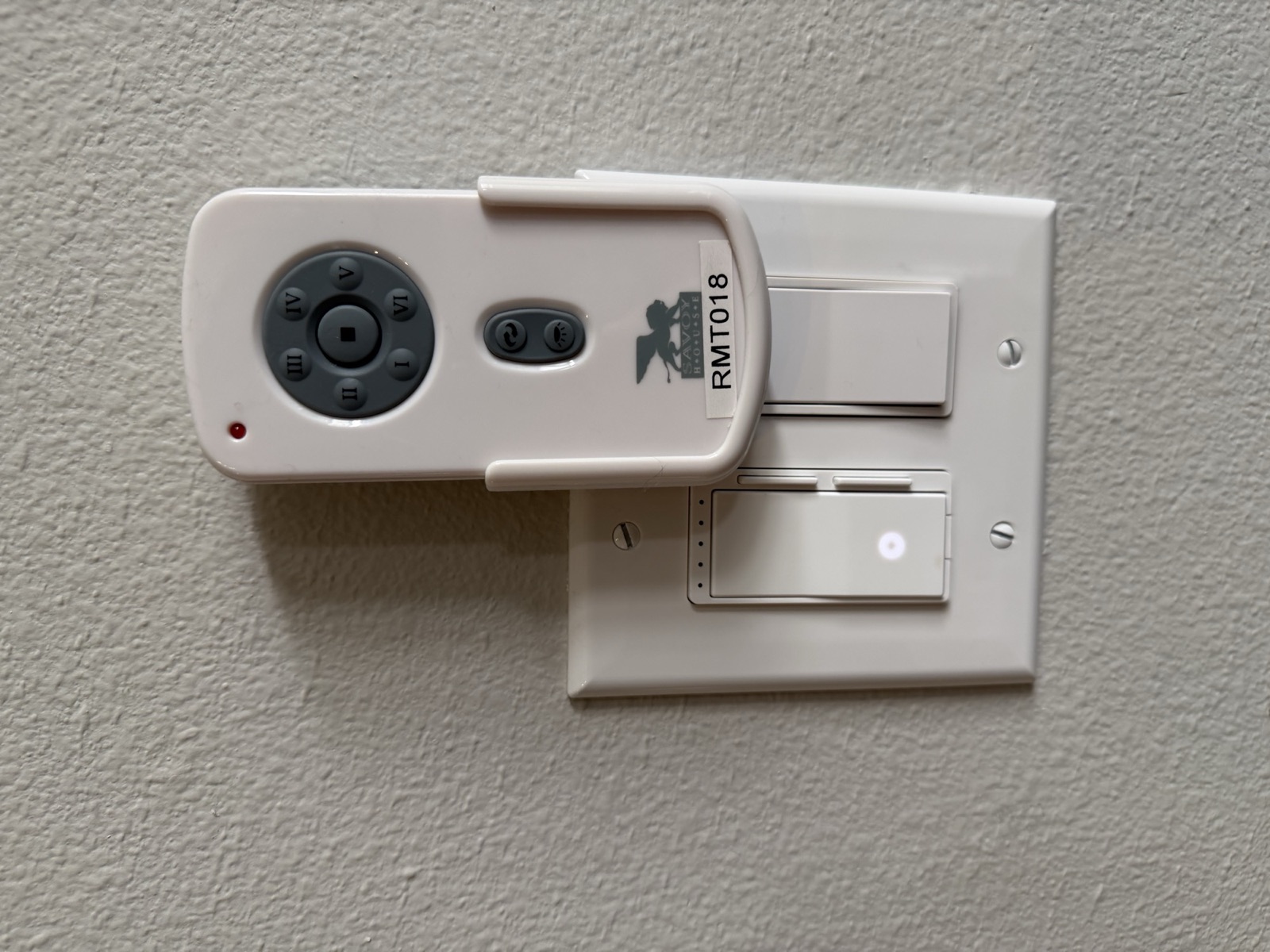
Two ceiling fans, of two different makes: a Minka-Aire Concept I (model F517-BN) in the living room / great room, and a Savoy House fan — worked by a handheld RF remote, part RMT018, in a wall cradle — in the master bedroom. Both are smart-capable and neither is currently tied into a smart-home system.
At a glance
Two ceiling fans, two makes: a Minka-Aire Concept I (model F517-BN, brushed nickel) in the living room / great room, and a Savoy House fan in the master bedroom, worked by a handheld RF remote (part RMT018) kept in a wall cradle. Both are smart-capable and not currently connected to any smart-home system.
- Where
- Living room / great room — the Minka-Aire. Master bedroom — the Savoy House, with its remote cradle on the wall beside a two-gang switch plate.
- Must know
- On the master bedroom’s Savoy House fan the remote is effectively the only full control — losing it means losing access to most of its six speeds and its light dimming, so keep it in its cradle. The living-room Minka-Aire has its own separate remote; which one is to confirm — the F517-BN normally shipped with an RCS212 three-speed handheld. Whether spare remotes exist, or a pairing/DIP-switch code is recorded anywhere, is unconfirmed for either fan.
- Status
- Both fans are original to the 2017 build and in working order. Open items: the Savoy House fan’s own model plate, the living-room fan’s remote, and what the paddle switch and dimmer beside the master bedroom cradle control.
2Everyday use
Both fans work like any ceiling fan with a remote instead of a pull chain. The two are different designs with different remotes, so what applies to one does not necessarily apply to the other.
- Master bedroom (Savoy House): take the RMT018 remote out of its wall cradle and point it at the fan. Press one of the numbered buttons, I through VI, for the six fan speeds — higher numbers are faster. The central square button stops the fan. Use the two-position rocker (light-bulb icons) to turn the light on and off and to dim it.
- Living room (Minka-Aire Concept I): operate it with its own remote. Which remote that is, is to confirm at walkthrough — the F517-BN normally shipped with an RCS212 three-speed handheld with light dimming and reverse.
- Return whichever remote you used to its home — wall cradle, drawer — when done, so it is easy to find next time.
Two fans, two makes, two sets of parts
Seasonal direction — reverse it twice a year
The two unlabelled wall switches (master bedroom)
3Maintenance
- Remote batteries: the RMT018 (master bedroom) and the living-room fan’s remote may take different batteries — check the compartment on the back of each and record it here. To confirm, both.
- Dusting: wipe both fans’ blades periodically — a pillowcase slipped over each blade and pulled back catches the dust neatly. Built-up dust on blades is a common cause of a fan that seems to wobble more than it used to.
- Mounting hardware: check periodically that the canopy screws and blade-arm screws are still snug on both fans — a fan that develops a new wobble or noise usually just needs re-tightening, not replacement.
- Light kit compatibility: the Minka-Aire Concept I has an integrated opal-glass light kit built into the fan body. If the master bedroom’s adjacent wall dimmer turns out to control a fan light rather than something else, confirm it is compatible with that light kit — pairing an incompatible wall dimmer with an LED light kit is a common cause of flicker or hum, independent of anything being broken.
4Troubleshooting
- Remote does nothing: check the remote’s batteries first, then confirm the wall switch or breaker feeding that fan is actually on — a DC-motor fan with no power at the wall will not respond to the remote no matter what.
- Remote works from across the room but not up close, or only sometimes: a sign of a weakening battery even before it reads fully dead — replace and retest.
- Master bedroom — lost or broken RMT018 remote: the part number
RMT018does not appear in Savoy House’s current catalog; it is a legacy/OEM part that shipped bundled with this fan rather than being sold as a standalone accessory. Savoy House’s current equivalent for a DC-motor fan is the RMT-DC-UNIVERSAL (see Documents), but compatibility with this fan’s receiver and any pairing/DIP-switch code is not guaranteed — confirm before buying a replacement. - Living room — lost or broken Minka-Aire remote: if the fan uses an RCS212-family remote, Minka-Aire and third-party universal ceiling-fan remotes are widely available; check the fan’s own receiver/DIP-switch code (inside the canopy) before ordering one.
- Light won’t dim, or flickers (either fan): operate the light from the fan’s own remote alone first, to isolate whether an adjacent wall dimmer is the source of the problem.
- Fan direction seems wrong for the season: see the seasonal-reverse callout in Everyday use.
5Specs & identity
| Count | Two — living room / great room and master bedroom |
|---|---|
| Age & history | Both original to the 2017 build, in working order, with no failures or repairs |
| Smart-home capability | Both are smart-capable and not currently connected to any smart-home system; connecting either should be straightforward for an owner who wants it. Exact add-on/hub compatibility to confirm, for both. |
| Brand & model | Minka-Aire Concept I, model F517-BN — brushed nickel finish, silver blades, opal-glass integrated light kit |
|---|---|
| Blades / light kit | 3 blades, 52" sweep; integrated light kit under an opal-glass diffuser rather than a separate add-on kit |
| Model plate | To confirm — the fan’s own plate is inside the canopy or on the motor housing above the blades |
| Remote / control | To confirm — not the RMT018, which belongs to the master bedroom fan. The F517-BN normally shipped with an RCS212 three-speed handheld remote with full-range light dimming and reverse. |
| Motor type | A conventional 3-speed AC motor fits the RCS212 pairing — a different design from the master bedroom’s DC-motor fan. To confirm on the installed unit. |
| Reverse-direction control | To confirm — remote button vs. a switch on the motor housing |
| Brand | Savoy House |
|---|---|
| Remote part number | RMT018, printed on the remote and cradle — a legacy/OEM part number, not in Savoy House’s current catalog |
| Controls | Six numbered speeds, I through VI, a central stop button, and a two-position rocker for light on/off and dimming |
| Motor type | DC motor — six discrete speeds plus separate light dimming is the signature of Savoy House’s DC-motor control set. To confirm on the fan itself. |
| Fan model | To confirm — the fan’s own model plate is on the motor housing above the blades, or inside the canopy; it is not on the remote |
| Reverse-direction control | To confirm — remote button vs. a switch on the motor housing |
| Adjacent paddle switch (unlabelled) | Function to confirm |
| Adjacent slide dimmer (unlabelled) | Function to confirm — it has a 7-segment LED level bar and a small illuminated locator dot |
6Documents & links
- Minka-Aire — Concept I (F516/F517) instruction manual & warranty (PDF)
Official Minka Group asset (minkagroup.net redirects to minka.com — same file). Document header reads "Model Number F516/517," covering the living-room fan’s F517-BN. Assembly and warranty; it does not name a specific remote model for this finish. - Minka-Aire — F517L-BN product page (closest current listing)
The plain (non-LED) F517-BN has been discontinued and superseded in Minka-Aire’s current catalog by the LED F517L-BN; this is the closest live product reference for specs and downloads. Retailer listings for the original F517-BN describe an RCS212 three-speed handheld remote. - Savoy House — DC-motor fan remote operating instructions (PDF)
For the master bedroom fan. Operating and pairing instructions matching this remote’s layout — six-speed LEDs, light dimming, 2032 battery. Series-level; the fan’s exact model is still to confirm. - Savoy House — Universal Remote for DC Motor Ceiling Fan (RMT-DC-UNIVERSAL)
Savoy House’s current-catalog DC-motor fan remote — the closest match to the master bedroom fan’s remote layout, offered as a likely replacement, not a confirmed exact match for RMT018. - Savoy House — warranty & support
Official Savoy House warranty page; use for support once the master bedroom fan’s own model is identified. - ENERGY STAR — ceiling fan installation & usage tips (seasonal direction)
Official basis for the summer-counterclockwise / winter-clockwise guidance above. Applies to both fans.
Section 8Technical reference ExpandCollapse
The engineering layer — for a buyer's technician, or a curious owner.
Why the two fans behave so differently. The master bedroom’s Savoy House fan is a DC-motor design: an electronically commutated motor driven by a receiver in the canopy, which is what allows six discrete speeds from a handheld rather than the three a conventional pull-chain or wall-controlled fan offers. DC fans draw markedly less power, run quieter at low speed, and start and stop smoothly — but they are inseparable from their electronics. There is no pull chain to fall back on, and the receiver, remote and motor are matched as a set. The living room’s Minka-Aire Concept I is the conventional counterpart: an AC motor with a small number of speeds, an integrated opal-glass light kit in the fan body, and a simpler handheld. Neither fan’s remote, receiver, or parts will work on the other.
What that means for a lost remote. RF ceiling-fan remotes talk to a receiver tucked inside the fan’s canopy, usually paired either by a DIP-switch code set identically on both halves or by a learn-mode button press. If a remote is lost, the replacement has to match the receiver, not just the fan brand — which is why the practical fix is to drop the canopy, read the receiver’s model and DIP code, and buy to that. RMT018 is a legacy Savoy House part that shipped bundled with the master bedroom fan and was never a standalone catalogue item, so a like-for-like replacement is unlikely to be available; Savoy House’s current RMT-DC-UNIVERSAL is the nearest equivalent for a DC-motor fan, and whether it will adopt this receiver is worth confirming before buying. Recording each fan’s receiver model and DIP code somewhere durable is a fifteen-minute job that saves a much longer one later.
Seasonal reverse, and why it works. In summer a fan run counterclockwise pushes air straight down; the moving air does not lower the room temperature at all, but it accelerates evaporation from skin, which is felt as several degrees of cooling. That is why a fan left running in an empty room is pure waste — it cools people, not rooms. In winter the same fan run clockwise at its lowest speed pulls air up the middle of the room and pushes it gently down the walls, mixing the warm layer that has collected at the ceiling back into the occupied space without producing a draught. In a room with a vaulted or tray ceiling — both present in this house — that stratified warm layer is a real quantity of heat, and the winter reverse is worth the two minutes it takes.
Still open on this page: the master bedroom fan’s own model plate (motor housing or canopy); the living-room fan’s actual remote, to confirm or correct the RCS212 expectation, and a look at its motor-housing plate; what the paddle switch and slide dimmer beside the master bedroom cradle each control; whether a reverse-direction control lives on each remote or on each motor housing; whether spare remotes exist and whether a DIP-switch or pairing code is recorded anywhere, for both fans; each remote’s battery type; and which smart-home add-on or hub each fan is compatible with.