03·FIR
Gas Fireplace
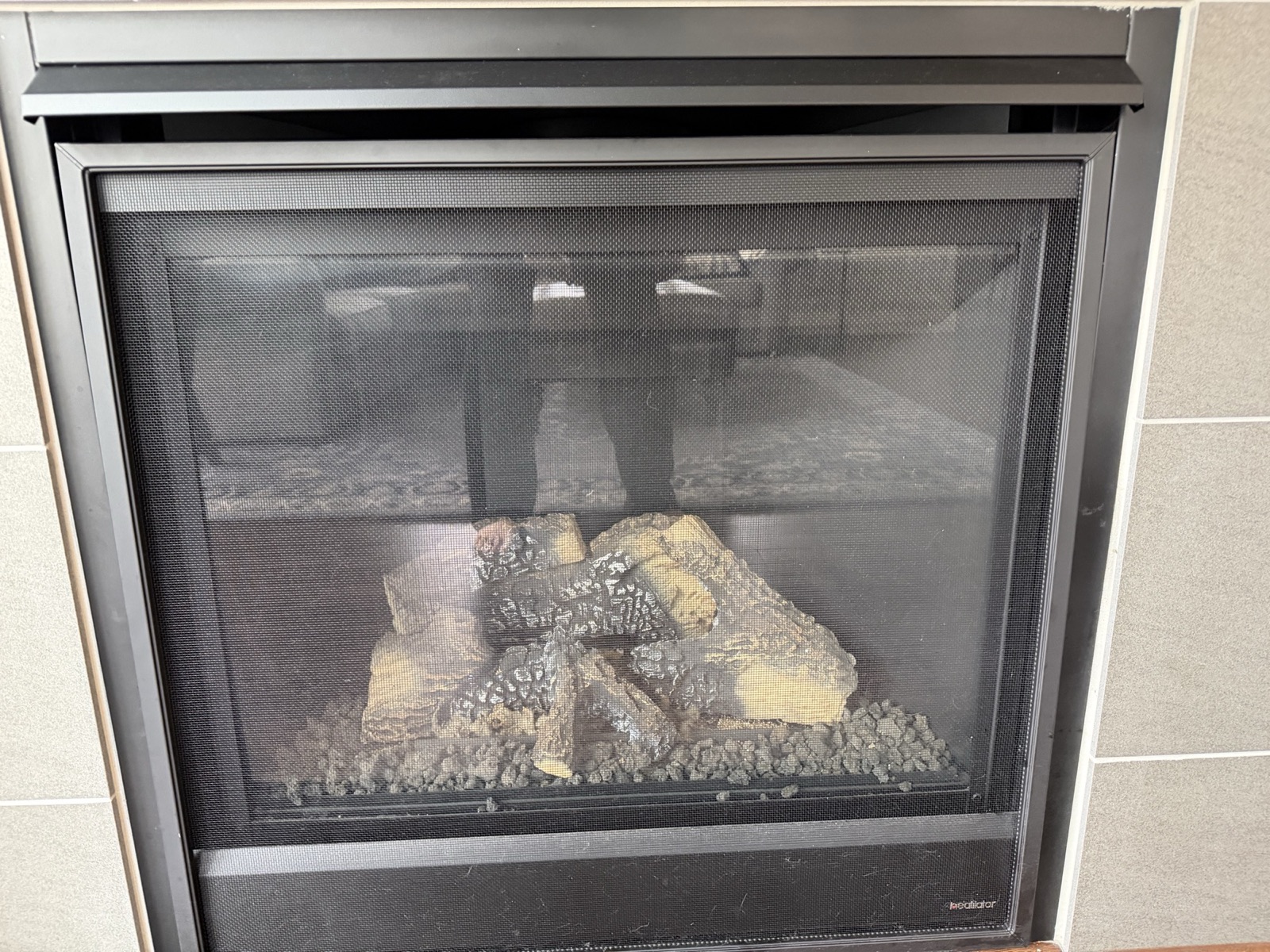
A direct-vent gas fireplace with ceramic logs, an ember bed, and a factory glass safety screen — a Heatilator NDV3630I-B. It's in the living room (family/great room), the only fireplace in the house, controlled by a wall switch on the left side of the bump-out. Its IntelliFire electronic ignition includes a battery backup, so it can still run during a power outage.
At a glance
A Heatilator NDV3630I-B direct-vent gas fireplace. It has a ceramic log set on an ember bed and a factory glass safety screen, and uses Heatilator's IntelliFire electronic ignition system, which includes a battery backup specifically for use during a power outage (see Everyday use). "Direct-vent" means it's a sealed-combustion appliance: it draws combustion air from outside and exhausts outside, not into the room.
- Where
- The living room (the family/great room), on its east wall. It is the only fireplace in the house.
- Must know
- The glass front gets dangerously hot during and for a while after use — see the safety callout below before anyone with kids or pets is near it. It's turned on and off at a wall switch on the left side of the bump-out — no remote or wall thermostat is involved. It can also run with the power out, if two D-cell batteries are on hand — see the power-outage callout.
- Status
- Installed and in working order. Original to the 2017 build. Whether spare D-cell backup batteries are on hand, the gas shutoff location, and the outside vent-termination location are still to confirm.
2Everyday use
This fireplace is switch-operated, not remote- or thermostat-controlled — the whole everyday routine is one wall switch.
A direct-vent gas fireplace burns behind a permanently sealed glass front. A dedicated pipe (usually a coaxial two-in-one pipe) brings combustion air in from outside and carries exhaust back out, so the fire never draws on — or exhausts into — the room's air. That sealed design is also what makes the safety screen effective: because the firebox is closed, a screen can sit between the room and the glass without interfering with combustion. This is different from a "vent-free" gas fireplace (which burns room air directly) or a wood-burning fireplace with an open flue.
The switch
- Find the wall switch on the left side of the bump-out in the living room.
- Flip it on. This unit uses Heatilator's IntelliFire ignition — an electronic intermittent pilot system, meaning the pilot lights only when the main burner is called for, rather than staying lit continuously. Under normal household power, the wall switch is all you touch.
- A simple wall-switch-controlled unit like this one is just on/off, with no variable flame or heat adjustment at the switch itself — the burn-rate (HI/LO) knob is inside the control cavity and is an install-time adjustment, not a day-to-day control.
- Flip it off at the same switch. Because IntelliFire is an intermittent pilot (not a standing pilot), the pilot goes out along with the main burner — there is no continuously-lit pilot flame to see either way.
It runs during a power outage
The glass gets dangerously hot
Factory safety screen
3Maintenance
Annual professional inspection
- Backup batteries: two D-cell batteries live in a tray in the control cavity for power-outage use only — they are not installed during normal operation. Keep a spare, unopened pair near the fireplace (in a kitchen drawer or the utility closet, not necessarily in the unit itself) so an outage doesn't become the moment you discover you don't have them.
- Glass cleaning: clean only when cool, and use a cleaner rated for fireplace glass (or the manufacturer's recommended product) — household glass cleaners, especially ammonia-based ones, can etch or discolor the ceramic-glass surface.
- Exterior vent termination: periodically check the outside vent cap (wherever it exits the house — location to confirm) for nests, spider webs, or debris; a blocked termination is a common cause of poor performance or shutdown on a direct-vent unit.
- Gas shutoff valve: know where the fireplace's dedicated gas shutoff is to confirm/photograph — you should be able to shut off gas to just this appliance without affecting the rest of the house.
4Troubleshooting
- Won't light at all (power is on): check the wall switch first — make sure it's fully on and that nothing has tripped its circuit at the panel — before assuming a gas problem. If the switch checks out, confirm the gas shutoff valve (once located) is fully open.
- Won't light and the power is out: the fireplace won't switch itself onto battery automatically. Access the control cavity, insert two D-cell batteries into the battery tray (correct polarity — reversed batteries can damage the ignition module), then flip the same wall switch as always. See the power-outage callout in Everyday use.
- Pilot won't stay lit, or won't light on a call for heat: on an IntelliFire electronic ignition, this is usually a sign the flame-sensing rod or the ignition module needs attention, or a low battery if you're currently running on backup power — this is a job for a qualified technician, not a DIY fix.
- Flame looks weak, yellow/sooty, or the glass blackens quickly: can indicate a combustion or venting problem (partial blockage, incorrect gas pressure) — stop using the fireplace and call a professional; a properly tuned gas flame should burn blue at the base without sooting the glass.
- For anything beyond a switch that's off, a tripped breaker, or inserting backup batteries: gas appliances are not a DIY troubleshooting category — call a hearth professional (see Documents for how to find a Heatilator-authorized dealer).
5Specs & identity
| Type | Direct-vent gas fireplace (sealed combustion, vents to outside) with ceramic logs, ember bed, and a factory glass safety screen |
|---|---|
| Brand | Heatilator (Hearth & Home Technologies) |
| Model | Heatilator NDV3630I-B. (The "3630" denotes the 30" × 22⅝" viewing area in a 36" rough opening — not the appliance's overall width.) |
| Serial number | owner's edition |
| Room location | Living room (family/great room), east wall. This is the only fireplace in the house. |
| Control method | Wall switch, on the left side of the bump-out. No remote and no wall thermostat/control panel. |
| Ignition type | Heatilator IntelliFire™ — an electronic, intermittent-pilot ignition system. Includes a factory-installed D-cell battery-backup tray in the control cavity, for use during a power outage — not populated by default; see the power-outage callout in Everyday use. |
| Install date | Original to the 2017 build — already set in its framed chase, wrapped in factory protective plastic, in a March 2017 framing-stage photo; the unit's own owner's manual, with model/serial filled in by the installer, was on site by July 2017. |
| Venting | Direct-vent (dedicated intake/exhaust piping to the exterior) — does not use or affect room air |
|---|---|
| Fuel | The house is otherwise gas-served (natural gas tankless water heater, furnace); confirm this fireplace runs on natural gas rather than propane |
| Gas shutoff location | To confirm/photograph |
| Vent termination location | To confirm/photograph (exterior wall or roof cap) |
| TV wall prep | The wall above the fireplace was pre-wired at build time for a wall-mounted television: a dedicated duplex receptacle plus a separate low-voltage pass-through plate, for an HDMI or network cable to drop down inside the wall. Blocking for the mount was set at framing, and a heavy full-motion articulating mount is installed. |
|---|---|
| The mount itself | A heavy-duty, full-motion articulating mount was installed at build time (not a fixed or simple tilt bracket) — which implies solid in-wall blocking/backing capable of carrying a heavier panel. Useful if a different or heavier TV is ever hung here: the structural support is already in place. |
| The two grey panels flanking the mount | Two flat, unframed, light-grey rectangular panels flank the TV mount in the same 2017 photo, standing slightly proud of the drywall, with no visible frame, fasteners, or grille perforation at that resolution. Open — not resolved. Two candidate readings, no more than that: (a) a pair of paintable, frameless in-wall speaker grilles for an L/R pair flanking the TV — if so, this would be a second in-wall speaker pair the manual doesn't otherwise record, distinct from the separate media room's own wiring; or (b) surface-applied backing/patch panels left over from the mount installation. To confirm at walkthrough — do not assume either answer without looking. |
6Documents & links
- Heatilator — installation & owner's manual downloads
Official Heatilator owner-support page. Heatilator routes service, parts, and troubleshooting through authorized dealers rather than shipping parts direct — this page also links to a dealer locator. - Heatilator NDV3630I-B (Novus) — owner's manual (PDF, exact model)
Official Hearth & Home Technologies download — document 2382-981, the manual matching this unit. Covers NDV3630I-B, NDV3933I-B, NDV4236I-B, NDV4236I-NVR, NDV4842I-B. Section J covers operation during a power outage. - Heatilator "ND" series (predecessor family) — owner's manual (PDF, archived locally)
What is actually archived in docs-archive/ today, per the docs-archive manifest — downloaded before the exact model was known. This document covers the ND3630/3933/4236/4842 (and I/L/IL variant) family, a related but different, older model line from our unit's NDV3630I-B, and it predates the IntelliFire power-outage section cited above. Kept here as a local reference; a Phase B follow-up should re-archive the exact 2382-981 PDF (linked above) to replace this placeholder. - CSIA — homeowner resources (annual inspection, NFPA 211)
Chimney Safety Institute of America guidance citing NFPA 211: chimneys, fireplaces, and vents should be inspected at least once a year, gas included. - CPSC — protect children from burns on glass-front gas fireplaces
U.S. Consumer Product Safety Commission guidance on glass-front burn hazards and protective barriers — the basis for the warning above.
Section 8Technical reference ExpandCollapse
The engineering layer — for a buyer's technician, or a curious owner.
Why "direct-vent" is the safer sealed-glass design: because combustion air and exhaust both travel through a dedicated pipe to the outside, the firebox is a closed system — the glass front can be permanently sealed rather than left as an open hearth. That sealing is what makes the mandatory safety screen possible: the screen sits in the air gap between the room and the sealed glass without disturbing combustion, unlike an open wood fireplace where a screen only ever catches sparks. It also means a direct-vent fireplace, unlike a vent-free one, cannot introduce combustion byproducts into the room under normal operation.
Owner's edition
Full details in the owner's edition — serial numbers, configuration and identity details continue in the complete manual, handed to the buyer at closing.
The power-outage capability, and how it actually works: Heatilator's IntelliFire ignition is an electronic intermittent pilot system — the pilot lights only on a call for heat, rather than burning continuously — and it includes a factory battery-backup tray for exactly this scenario. It is not automatic, though: the fireplace does not sense a power failure and switch itself to battery. Someone has to open the control cavity, load two D-cell batteries into the tray (with correct polarity — reversed batteries can damage the ignition module), and then operate the ordinary wall switch. Once power is restored, Heatilator's own instructions are to remove the batteries again rather than leave them in continuously, since high appliance temperatures shorten battery life. The practical version of this fact: this fireplace can genuinely provide heat and light on a dark, cold, no-power evening, but only if a spare pair of D-cell batteries is actually on hand when it matters — see the maintenance section.
The pre-wired TV wall: the wall above the fireplace was planned for a wall-mounted television at framing, not adapted afterwards. Horizontal blocking was set in the chase to carry the load, and the finished wall has a dedicated duplex receptacle plus a separate low-voltage pass-through plate so an HDMI or network cable drops down inside the wall rather than hanging across it. A heavy, full-motion articulating mount is installed. This is the kind of build quality that becomes invisible the moment the drywall goes up. Two flat grey panels flank the mount and their identity is a genuinely open question (see specs above) — resist the temptation to call them speakers without looking.
What to gather to finish this page: the gas shutoff and outside vent-termination locations; confirmation of natural gas vs. propane; whether/when the fireplace has last been professionally serviced; whether a spare pair of D-cell backup batteries is actually kept on hand; and the identity of the two grey panels flanking the fireplace-wall TV mount.