03·BAR
Bar & Butler’s Pantry
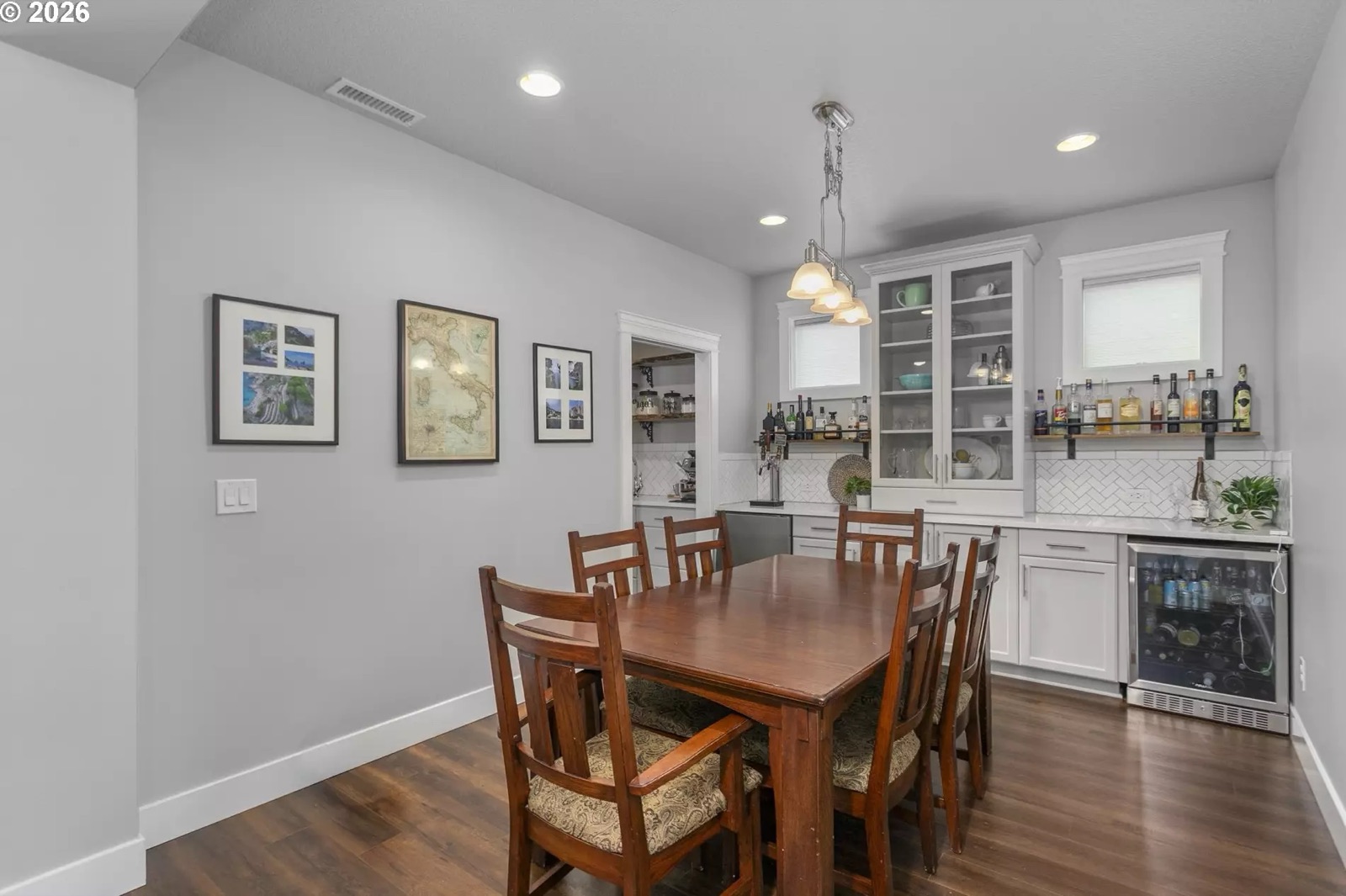
Two connected spaces: a built-in entertaining bar running the length of the formal dining room — triple-tap kegerator at one end, beverage refrigerator at the other — and, through the wall beyond it, the butler’s pantry with its own sink, counter and espresso machine.
At a glance
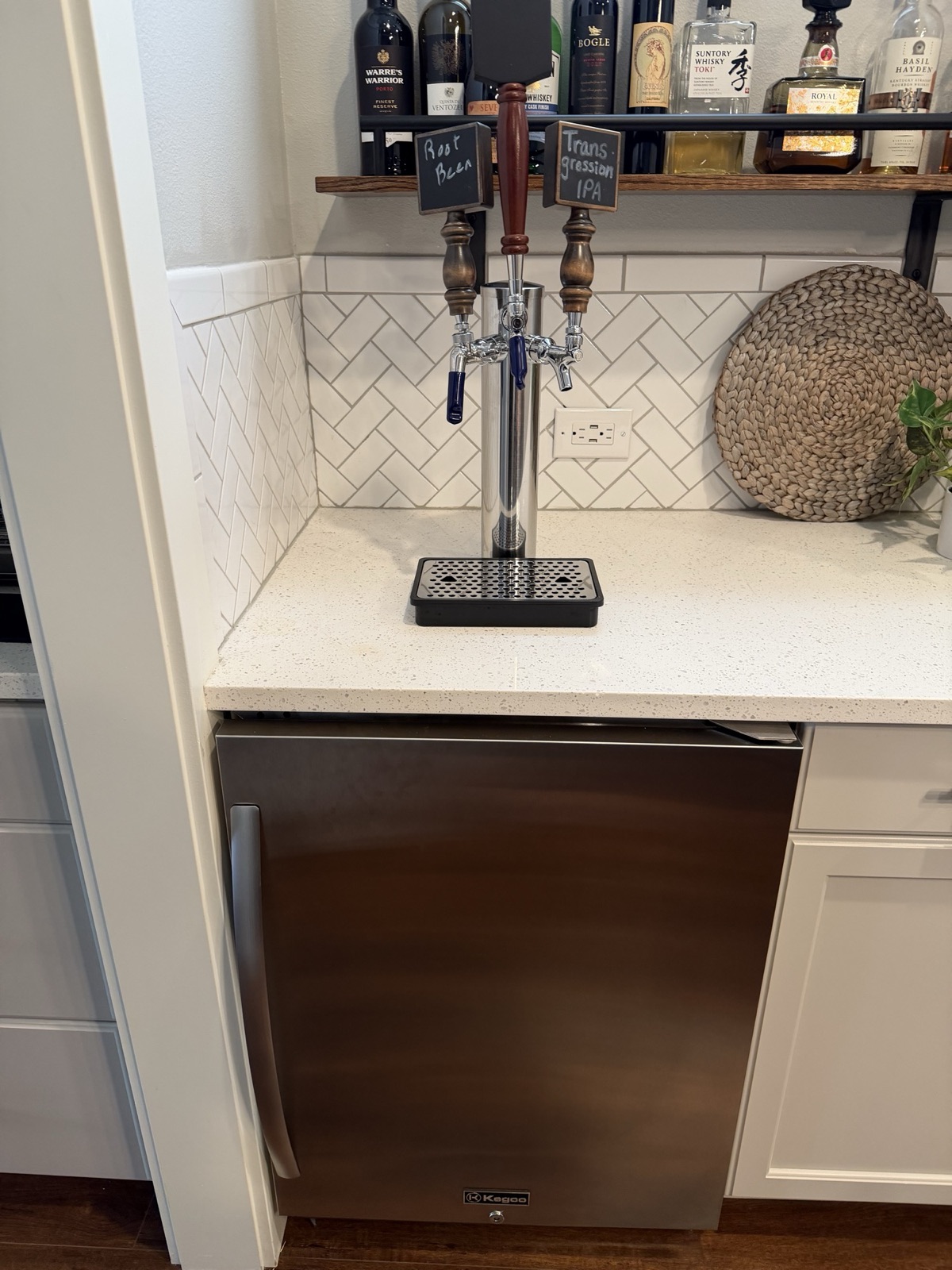
A built-in bar filling one wall of the formal dining room, anchored at both ends: a Kegco triple-tap built-in kegerator at the far east end (24"-wide under-counter unit with a keyed lock, sized for three standard 1/6-barrel “sixth-barrel” kegs) and a glass-door beverage refrigerator at the far west end (branded NewAir), with a lighted glass display cabinet and open bottle shelves spanning between them. The bar and its built-ins are included with the house, no exception.
- Where
- The bar is in the formal dining room. The butler’s pantry is a different room — through the wall immediately beyond the kegerator, entered by a pocket door from the dining room and opening on into the kitchen through a cased opening. The walk-in pantry is a third room again, and its only door opens off the butler’s pantry.
- Must know
- The kegerator runs on CO2 from a compressed-gas cylinder inside or beside the under-counter unit. That cylinder needs the same respect as any compressed gas: see the safety callout below before you swap a keg or a tank. All kegerator hardware — couplers, lines, the cleaning kit, and CO2 hardware — stays with the house.
- Status
- Installed and in use. The kegerator and the beverage refrigerator are original to the 2017 build, like every appliance in the house — never replaced, never a failure, never a service call. Exact model and serial numbers for both, and the CO2 cylinder size, are still to gather.
2Everyday use
Two spaces, one page. The bar is for pouring and serving; the butler’s pantry through the wall is the working counter behind it. The one thing to actually be careful with is the CO₂ cylinder that makes the taps work.
The bar, end to end
The bar occupies a full wall of the dining room and is anchored at both ends. At the far east end, beside the doorway through to the butler’s pantry, sits the triple-tap kegerator — a built-in under-counter cabinet with its tap tower on the counter above. At the far west end sits the glass-door beverage refrigerator. Between the two runs the counter, a tall lighted glass-front display cabinet for glassware and bottles, and open bottle shelving. Knowing the two ends is the fastest way to describe the whole run: cold beer at one end, cold bottles at the other, everything else in the middle.
Pouring from the kegerator
- Pick a tap — all three are wired for a keg (or bottle/cornelius keg) at once, whether that’s three of the same beverage or three different ones.
- Pull the tap handle smoothly toward you and hold a glass at an angle under the faucet, straightening the glass as it fills to control the head.
- If the pour is mostly foam: the keg may need to settle after being moved/tapped, the line may need a cold rest, or the CO2 pressure may need adjusting — see Troubleshooting.
Three taps, three drinks
CO₂ safety
Swapping a keg
- Release pressure at the regulator, disconnect the coupler from the empty keg (twist and lift per the coupler type on this system), swap in the full keg, reconnect, and let pressure re-build before pouring.
- Give a freshly tapped/moved keg a few minutes to settle before pouring — a keg that was just jostled pours mostly foam.
Beverage refrigerator
- A NewAir-branded glass-door under-counter unit at the west end of the bar, with its own digital thermostat — set the zone to what you are storing (whites and sparkling run cooler, reds a bit warmer; if it is a dual-zone unit, each side has its own control).
- Don’t overload the door racks — glass bottles are heavy, and an overloaded door strains the hinge over time.
The butler’s pantry
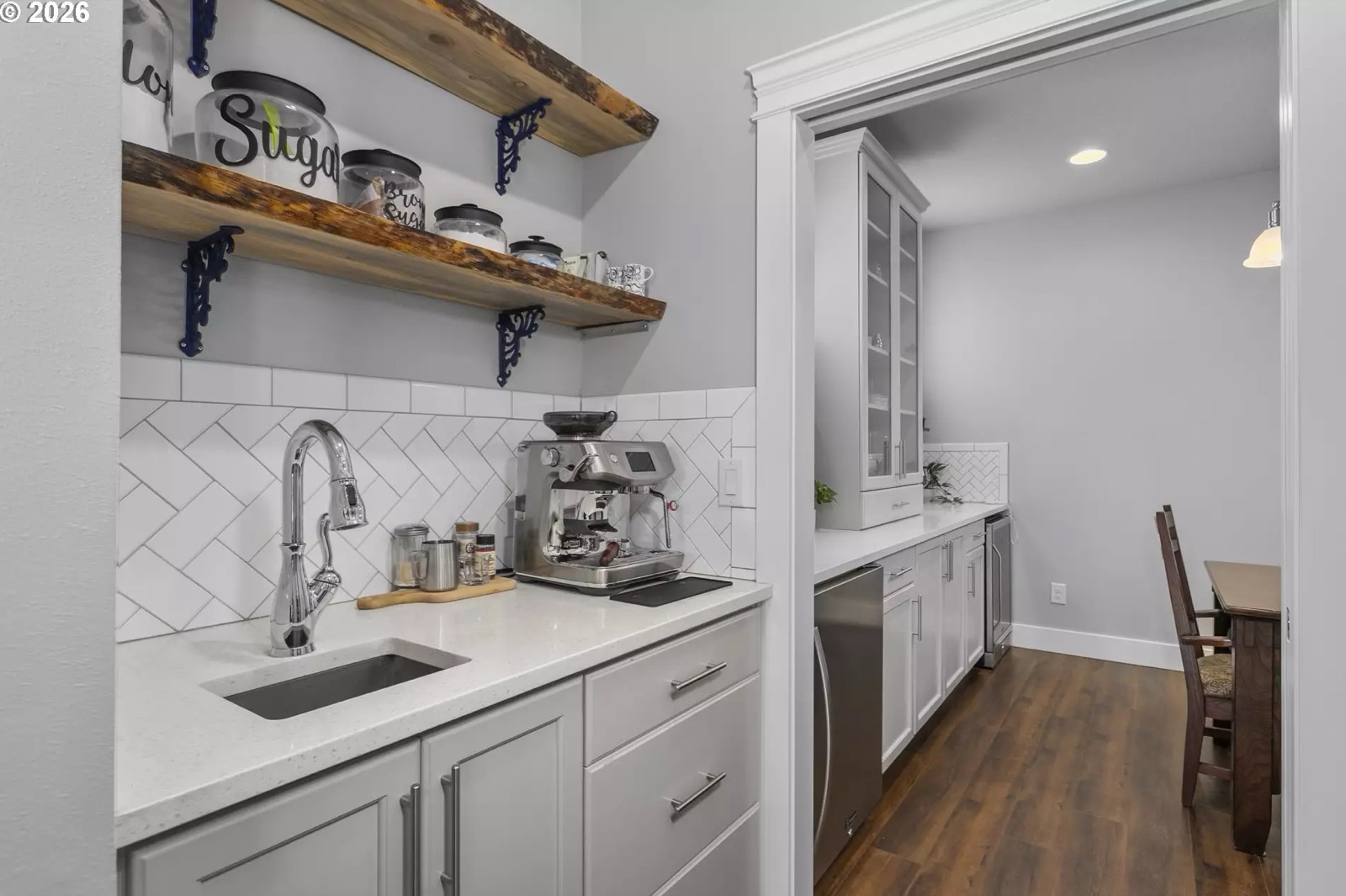
The butler’s pantry is not the walk-in pantry, and it is not part of the bar — it is its own room, through the wall to the left of the kegerator. It holds a quartz counter with an undermount stainless sink and a pull-down faucet, cabinets below, two live-edge open shelves above on cast-iron brackets, and it is where the espresso machine lives. It is also the route between the dining room and the kitchen: pocket door on the dining side, cased opening on the kitchen side.
- Having a second sink here is the point of the room. Drinks get made, glasses get rinsed and coffee gets pulled without any of it happening in the middle of the kitchen or across the bar where guests are standing.
- The walk-in pantry opens off this room — its only door. If you are looking for the shelved food-storage room, it is here, not off the kitchen.
3Maintenance
Clean the beer lines on a schedule
- CO2 cylinder: most home/beverage-supply shops will inspect, refill or exchange it — cylinders need periodic hydrostatic testing (typically every 5 years, stamped on the cylinder collar) like any compressed-gas tank.
- Kegerator drip tray: empty and rinse regularly — spilled beer left to sit gets sticky and attracts fruit flies.
- Beverage refrigerator: vacuum the condenser coils/vents at the base occasionally (dust buildup makes the compressor work harder); wipe door gaskets clean so they keep sealing.
- Faucets/taps: disassemble and soak the faucet parts when you clean the lines — residue builds up inside the faucet itself, not just the tubing.
- Butler’s pantry sink: nothing scheduled beyond the usual — but it is the sink in the house most likely to sit unused for weeks at a time, so run it occasionally to keep the trap from drying out and letting sewer gas through.
- Cleaning kit already on hand: the full keg-line cleaning kit and CO2 hardware stay with the house — no need to buy anything before the first line cleaning.
4Troubleshooting
- All foam, no beer: most common causes, in order of likelihood — CO2 pressure set too high for the line length/keg style, a keg that was just moved and needs to settle, warm beer lines (temperature not stabilized after a keg swap), or a line that needs cleaning (buildup narrows the tubing and increases turbulence).
- Weak/flat pour: CO2 pressure too low, a nearly empty CO2 tank, or a loose coupler/fitting leaking gas before it reaches the keg.
- No CO2 flow at all: check the tank valve is open (not just the regulator), and that the tank isn’t empty — an empty cylinder is common to overlook since the regulator gauge can look normal until it suddenly isn’t.
- Beverage fridge running warm: check the door seal and that nothing is blocking the vents at the base; like any compressor fridge it needs airflow around/under it to reject heat.
- Hissing near the cabinet: a gas leak at a fitting — this is the one to take seriously. Shut the tank valve, ventilate the area, and don’t light anything nearby (though CO2 itself isn’t flammable, don’t assume that about everything stored near it) until you’ve found and fixed the leak.
5Specs & identity
| Make | Kegco |
|---|---|
| Position | Far east end of the bar run, beside the doorway through to the butler’s pantry |
| Configuration | 24"-wide built-in/undercounter refrigerated cabinet, right-hinge door, factory keyed lock, curved bar handle |
| Taps | Three, sized for three standard 1/6-barrel (“sixth-barrel”) kegs run at once |
| Model | A Kegco triple-tap built-in/undercounter model exact SKU to gather — read the compressor-housing rating plate; the black-stainless door finish is one of Kegco’s indoor (not outdoor-rated) triple-tap lines. |
| Serial number | owner's edition |
| CO2 cylinder size | To gather (common home sizes are 5 lb or 10 lb); location (inside cabinet vs. elsewhere) also to confirm |
| Included hardware | All kegerator hardware stays with the house, including couplers, lines, the cleaning kit, and CO2 hardware |
| Age & history | Original to the 2017 build. Never replaced; no failure and no service call. |
| Make | NewAir |
|---|---|
| Position | Far west end of the bar run |
| Type | Glass-door under-counter beverage/wine refrigerator with its own digital thermostat |
| Zones | A single storage compartment for wine and bottles together confirm single- vs dual-zone at walkthrough |
| Model | To gather — NewAir makes several under-counter dual-zone wine/beverage models; the model plate is usually inside the door frame or on the compressor housing at the back |
| Serial number | owner's edition |
| Age & history | Original to the 2017 build. Never replaced; no failure and no service call. |
| Run | One full wall of the formal dining room, kegerator at the east end and beverage refrigerator at the west end |
|---|---|
| Cabinetry | Quartz counter, a tall lighted glass-front display cabinet, open bottle shelving, and cabinets below |
| Additional appliance | A second built-in stainless appliance sits next to the beverage refrigerator — possibly an ice maker or a second dishwasher for barware. Identify at walkthrough |
| What it is | A separate room through the wall east of the kegerator — not the walk-in pantry, and not part of the bar |
|---|---|
| Doors | Pocket door from the formal dining room; cased opening through to the kitchen. The walk-in pantry’s only door also opens off this room. |
| Counter & sink | Quartz counter with an undermount stainless sink and a pull-down chrome faucet |
| Storage | Cabinets below the counter; two live-edge wood open shelves above on cast-iron brackets |
| Finishes | White herringbone tile backsplash, matching the kitchen’s cooking wall |
| Espresso machine | Lives on this counter. The built-in cabinetry, counter and sink stay with the house; whether the espresso machine itself does is to confirm |
6Documents & links
- Kegco — contact & support
Official Kegco support contact; use once the exact triple-tap SKU is known to request the matching manual. - Kegco HK38BSU-2 (24" dual-tap built-in kegerator) — owner’s manual (PDF)
Linked live from the Kegco storefront. Series-level: the manual is titled generically "HK-38 Full Size Kegerator", and the house unit is a triple-tap build, so the exact SKU is still open. - Micro Matic — CO2 exposure limits & safety (OSHA/ACGIH limits, ventilation guidance)
Authoritative draft-industry reference on CO2 exposure limits and ventilation. - KegWorks — how often to clean draft beer lines
Cites the Brewers Association Draft Beer Quality Manual for cleaning cadence. - NewAir — support & manuals
Once the exact beverage-refrigerator model is known, find and archive its manual here. - NewAir AWB-360DB wine/beverage refrigerator — owner’s manual (PDF)
Closest live NewAir match — a 24" built-in glass-door beverage fridge. Series-level; exact model still open.
Section 8Technical reference ExpandCollapse
The engineering layer — for a buyer's technician, or a curious owner.
For the home-bar enthusiast: how the run is laid out, what a triple-tap actually buys you, and the CO₂ system behind it.
The layout, and why the two ends matter
This is a bar built into a dining room rather than a bar room, and the layout reflects that. Both pieces of refrigeration are pushed to the ends of the run — kegerator east, beverage refrigerator west — which leaves the entire middle of the wall as counter, display cabinet and shelving. Two people can work the bar without colliding, guests can stand at the middle without standing in front of a door someone needs to open, and the two compressors are as far apart as the wall allows. It also means the kegerator ends up next to the doorway into the butler’s pantry, so kegs, CO2 cylinders and anything else awkward come and go through the pantry rather than being carried across the dining room.
Triple-tap, and a bit of history
- The kegerator is Kegco — the badge with the stylized "K" is on the door.
- It is a 24"-wide built-in/undercounter unit, right-hinge door, with a factory keyed lock next to the badge and a curved bar handle, from Kegco’s undercounter line. The exact SKU is still open pending a rating-plate check; the black-stainless door finish narrows it to the indoor rather than outdoor-rated models.
- The tower is a genuine triple-tap, sized for three standard 1/6-barrel (“sixth-barrel”) kegs run at once. It has poured beer, cider and root beer at the same time.
- The drip tray is mounted to the tile backsplash behind the tower rather than cut into the counter, so it lifts out and is emptied by hand unless it turns out to be plumbed to a drain — to confirm.
CO₂ system, briefly
A standard home kegerator setup is: CO2 cylinder → regulator (set to each keg’s serving pressure, typically in the 10–12 psi range depending on beer style and line length) → gas line → keg coupler → beer line → tower → faucet. With three taps running independent beverages at once, a multi-body/manifold regulator (a separate gauge and output per keg) is the arrangement that makes sense — a single-gauge regulator feeding three kegs at one pressure would pour some of them wrong if the styles or line lengths differ, which is exactly the situation a bar that has run beer, cider and root beer together is in.
Why the ventilation callout matters here specifically
This bar sits in a normal interior room, not a garage or a dedicated keezer with obvious airflow — CO2 released from a slow leak or a fast disconnect has nowhere to go but the room. It takes a genuinely large, fast leak in a small closed room to reach hazardous concentrations, but "odorless and heavier than air" is exactly the combination that makes small, tightly-built cabinets worth a second thought — hence keeping the tank valve closed when the system sits idle, and not treating the cabinet as airtight storage.
Three pantries is one too many names
The house has two rooms with "pantry" in the name and they are constantly confused, so, once, plainly. The butler’s pantry is the working pass-through between the dining room and the kitchen: counter, sink, shelves, cabinets, espresso machine, and the doorway beside the kegerator. The walk-in pantry is the shelved food-storage room whose only door opens off the butler’s pantry — it is covered on the Kitchen page. Neither is the bar, which is the run of cabinetry in the dining room itself.
What to gather to finish this page
- Kegerator exact model/serial (compressor housing data plate) and CO2 cylinder size.
- Whether the CO2 tank/regulator is inside the under-counter cabinet or plumbed from elsewhere, and whether the drip tray has a plumbed drain.
- NewAir model number (door interior or compressor housing) and whether it is single- or dual-zone.
- Identity of the second stainless appliance beside the beverage refrigerator.
- Whether the espresso machine stays with the house, or is personal equipment.