02·HVAC
Heating & Cooling
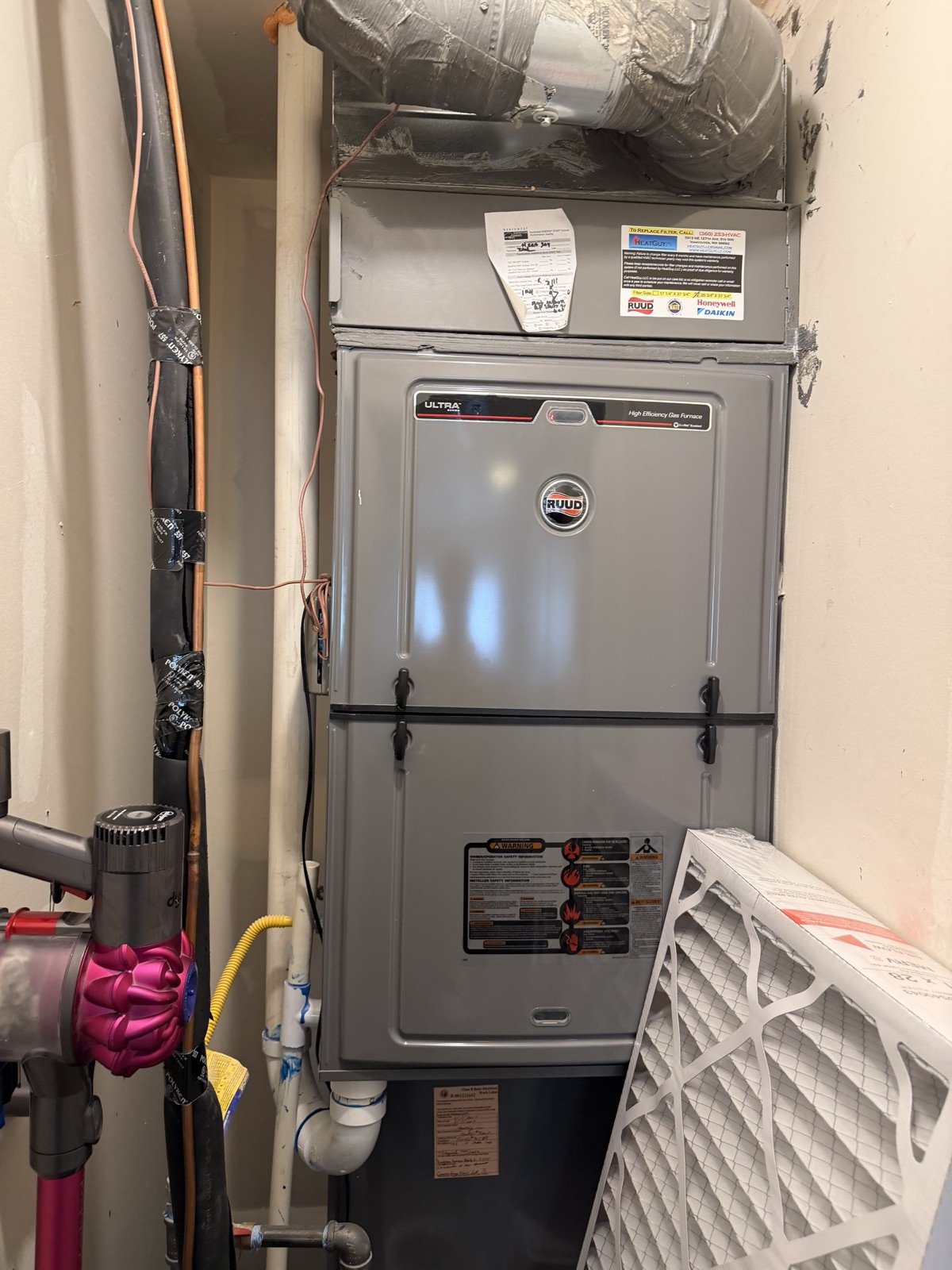
A Ruud Ultra Series high-efficiency gas furnace run by the Ecobee thermostat, a matched 3½-ton Rheem outdoor condenser, and a whole-house fresh-air ventilation control on the furnace cabinet.
At a glance
A Ruud "Ultra Series" high-efficiency condensing gas furnace heats the house and pushes warm air through ducts to registers in every room. The Ecobee thermostat is the control for the whole system — set the temperature there, not at the furnace. Cooling comes from a matched Rheem RA1342AJ1NA outdoor condenser (3½ tons / 42,000 BTU/h, 13 SEER) on its own concrete pad outside. A Honeywell Whole House Ventilation Control on the furnace cabinet brings in metered outdoor air on a schedule.
- Where
- The furnace, and the whole-house ventilation control mounted on its cabinet, live in a tight conditioned utility closet; to gather: which room or hallway that closet opens off. The AC condenser sits outside on its own concrete pad at bark-mulch grade against an exterior wall, with its disconnect on the siding directly above it; to confirm: which side of the house.
- Must know
- The single highest-leverage maintenance task is changing the filter on schedule — this unit takes a 20¾" × 27¾" MERV 8 media filter, not a small 1" throwaway. The service sticker calls for a filter change every 6 months plus annual professional service to keep the warranty valid. The contractor named on the unit is HeatGuy LLC (Vancouver, WA) — see Specs.
- Status
- Furnace, condenser and ventilation control are all original to the 2017 build and have never failed or required a repair. The Ecobee thermostat is the one piece of equipment in the house that has been replaced — upgraded to a newer model. Open items: the furnace’s model/serial plate, the condenser’s position on the house, and the ventilation control’s exact model.
2Everyday use
You almost never touch the furnace itself. Day to day, this system is the Ecobee thermostat and the vents.
A forced-air gas furnace works in three simple steps: it draws in room air through return grilles, heats that air by burning natural gas across a heat exchanger, and pushes the warmed air back out through supply registers (the vents you feel air coming from) using a blower fan. The thermostat is the brain that decides when this cycle runs and for how long.
- Set your target temperature on the Ecobee — that is the only day-to-day control for this system.
- Leave supply registers and return grilles unblocked — furniture, rugs, and curtains over a vent choke airflow and make rooms uneven.
- If a room runs hot or cold relative to the rest of the house, adjust that room’s register (open/close the damper blade at the vent) a little at a time rather than changing the thermostat.
The Ecobee is the brain
Whole-house ventilation
The house also has a controlled fresh-air ventilation system, separate from heating and cooling: a Honeywell Whole House Ventilation Control on the furnace cabinet brings in a metered dose of outdoor air on a schedule, rather than relying on incidental air leakage through the house. It works alongside the furnace and the Ecobee but is its own system, with its own switch.
The control has a three-position slide switch, set to the position you want for ordinary living: On / Optimized Ventilation — the control decides when to bring in fresh air, generally avoiding the most extreme outdoor temperatures. Override ventilates immediately for a set time (useful after painting, heavy cooking, or a party). Off / Remote Only stops automatic ventilation and waits for a separate remote or wall control to call for it.
Leave it on "On / Optimized Ventilation"
3Maintenance
The filter this furnace takes
- Filter changes: every 6 months, per the unit’s own service sticker (this is a media filter, not a 1"/monthly type) — the Ecobee also tracks runtime and can remind you.
- Spares are already on hand, and convey: there are at least two spare 20¾" × 27¾" MERV 8 filters in the house, plus a box of assorted fuses that includes the fuses this HVAC system uses. In practice the first year of filter changes is covered without a shopping trip, and a blown control-board fuse — the classic "furnace is completely dead but the breaker is fine" fault — can be fixed the same evening rather than waiting on a service call. To do at walkthrough: find both stashes, count what is there, and note where they are kept.
- Where the filter lives: in the filter cabinet mounted directly on the furnace, not at a central return grille.
- Registers & returns: vacuum supply registers and return grilles occasionally — dust buildup on a return grille is a quiet but real airflow restriction, same as a dirty filter.
- Annual professional service: the service sticker calls for this explicitly to preserve the warranty. HeatGuy LLC (Vancouver, WA — see Specs) is the contractor named on the unit; call to confirm whether they’re still under contract and to get on their annual reminder list. Standard scope: combustion safety check, heat exchanger inspection, blower and burner cleaning, plus a separate AC check in spring.
- Outdoor AC condenser: the Rheem RA1342AJ1NA sits on its own concrete pad against the house, set flush with a bark-mulch bed — which means bark, leaves and blown debris collect against the coil more easily than they would on a raised pad. Keep at least 2 ft clear on all sides and rinse the coil fins gently with a hose once a season; check it a little more often than the "once a season" rule of thumb given the mulch-level mounting.
- AC disconnect — no fuses inside: the grey box on the siding directly above the condenser is a Siemens WN2060, 60 A, non-fused pullout switch. Pulling the block only breaks the circuit mechanically — there is nothing inside it to blow or replace. If the AC is dead, the fault is at the breaker in the main panel or in the equipment itself, not in this box.
- Whole-house ventilation — the Service light: the Honeywell control on the furnace cabinet has a separate Service indicator next to its main status LED. If it lights, the system is asking for attention (most likely the outdoor intake needs checking) — treat it as a maintenance reminder, not an emergency. To gather: where the outdoor fresh-air intake hood terminates, so it can actually be checked for blockage.
4Troubleshooting
- No heat at all: first confirm the Ecobee is powered and set to Heat with a target above room temperature (see the Ecobee troubleshooting section for thermostat-side checks — blank screen, power, WiFi). If the thermostat looks fine and there is still no heat, follow the No-heat runbook for the full symptom → check → fix → call-a-pro sequence.
- Weak airflow / rooms not getting warm: check the filter first — a clogged filter is the single most common cause of weak airflow. Then confirm no registers or returns are blocked by furniture or closed dampers. If airflow is still weak after a fresh filter and open vents, that points to the blower or ductwork and is a call-a-pro item.
- Short-cycling (furnace turns on and off repeatedly in short bursts): the most frequent causes are a dirty filter (starves airflow, triggers a high-limit safety shutoff), a thermostat located somewhere unrepresentative of the room, or a furnace oversized for the space. Start with a filter check; if short-cycling continues with a clean filter, it needs a technician — repeated short-cycling wears out furnace components faster than normal operation.
- Furnace runs but the house never reaches temperature: check the filter, then check that all registers are open and unblocked. If those are fine, this can indicate duct leakage or a mechanical fault — a technician visit is the next step.
- AC not cooling: confirm the Ecobee is set to Cool with a target below room temperature. If the outdoor condenser still isn’t running, check the double-pole breaker for the AC in the main panel first — the wall-mounted Siemens WN2060 disconnect beside the condenser is non-fused, with nothing inside it to check; it only pulls out and reseats. See the Breaker trips runbook.
- Smell of gas near the furnace: this is not a troubleshooting item — leave the house, do not operate switches or the thermostat, and call the gas utility’s emergency line from outside. Treat any gas smell as an emergency, not a maintenance task.
Airflow problems: always start with the filter
5Specs & identity
| System type | Forced-air natural gas furnace, high-efficiency condensing (white PVC condensate/vent piping at the unit) |
|---|---|
| Brand / series | Ruud "Ultra Series" — oval Ruud badge and "ULTRA" nameplate on the door, with a "High Efficiency Gas Furnace" legend. Ruud is Rheem’s sister brand, so the Rheem parts and service network applies. |
| Age & history | Original to the 2017 build. No failure and no repair in nine years of service. |
| Exact model / serial | owner's edition |
| Location | A tight conditioned utility closet; to confirm which room or hallway that closet opens off |
| Electrical permit label | Class B Basic Electrical Work label B 001221652 is affixed to the unit — to confirm what work it documents (the handwritten fields need a legible close-up) |
| Gas shutoff valve (furnace) | To gather — usually a lever valve on the gas line near the unit; a yellow CSST gas line enters the mechanical space |
| Circuit / breaker | To gather — identify and label the furnace’s breaker in the main panel |
| Thermostat | Ecobee smart thermostat — see the Ecobee page for its own specs. This is the one replaced item in the house; everything else is original. |
| Make / model | Rheem RA1342AJ1NA |
|---|---|
| Serial | owner's edition |
| Manufactured / installed | Manufactured 11/2016; set on its pad, brazed and insulated by 2017-06-18 — original to the build, about 9½ years old as of 2026, with no failures or service calls against it |
| Capacity | 3½ tons / 42,000 BTU/h nominal — the "42" in the RA1342 model number |
| Efficiency tier | Rheem Classic® series, 13 SEER class (2016-era rating scale) — the one part of this house’s mechanical package that is base-efficiency rather than upgraded; a realistic expectation-setter for summer cooling cost |
| Refrigerant | R-410A, factory charge 105 oz (2977 g). R-410A is being phased down under the AIM Act, so servicing cost will drift upward over the unit’s remaining life, and a future replacement condenser will need the indoor coil changed too |
| Electrical | 208/230 V, 1-phase, 60 Hz. Min. supply circuit ampacity 24 A; max fuse/breaker 40 A; min fuse/breaker 30 A; HACR-type breaker required. Compressor R.L.A. 17.9 A / L.R.A. 112 A; fan motor 0.7 A, ⅛ HP |
| Design pressures | 450 PSIG high side / 250 PSIG low side |
| Location | On its own poured concrete pad, at bark-mulch grade, against an exterior wall, with the refrigerant line set entering the wall behind it and the disconnect on the siding directly above. Which face of the house it stands against — north, south, east or west — is not established. See the note in Technical reference. |
| Disconnect | Siemens WN2060 — 60 A, 240 V, 1-phase, Type 3R rainproof, non-fused pullout switch, wall-mounted directly above the unit. There are no fuses inside to check or replace — pulling the block only breaks the circuit mechanically. That it serves this condenser specifically is a to-confirm: the amperage and position fit, but no plate on the box names the AC. |
| Brand note | The furnace is badged Ruud; the condenser is badged Rheem. Same manufacturer (Rheem Manufacturing; Ruud is the sister brand), same parts and service network — two badges on one matched system is normal, not a mismatch. |
| What it is | A Honeywell Whole House Ventilation Control, screwed to the face of the furnace cabinet — a fresh-air ventilation control, not a smoke/CO detector or a second thermostat |
|---|---|
| Exact model | To gather — the faceplate reads only "Whole House Ventilation Control." Honeywell’s fresh-air control line at this vintage is the Y8150/W8150 family, which would fit, but nothing on the unit confirms it |
| Modes | Three-position slide switch: On / Optimized Ventilation (normal — the control decides when to ventilate), Override (ventilate now, on a timer), Off / Remote Only (ventilates only when commanded by a separate remote or wall control) |
| Current setting | Energized, green status LED lit, switch at On / Optimized Ventilation |
| Service indicator | A separate Service LED signals when the system wants attention |
| Location | On the furnace cabinet, in the same utility closet as the furnace |
| What it’s ducted to | To gather — a dedicated outdoor fresh-air intake duct into the furnace’s return plenum through a motorized damper is the standard arrangement for this class of control, but the duct run and the outdoor intake hood have not been traced |
| Filter size | 20¾" × 27¾", MERV 8 — a 4"/5" media filter (the alternate 17¼" × 27¾" size printed on the same sticker is unchecked and does not apply) |
|---|---|
| Filter change cadence | Every 6 months — failing to do so, or skipping annual professional service, is stated on the sticker to risk voiding the warranty |
| Spares on hand (convey) | At least two spare 20¾" × 27¾" MERV 8 filters, plus a box of assorted fuses including the type this HVAC system uses. To gather: exact count, storage location, and the fuse rating(s) that match the furnace control board — record the rating here so a replacement can be bought without guessing. |
| Known service contractor | HeatGuy LLC — Vancouver, WA. Phone (360) 253-HVAC (253-4822); email heatguyllc@gmail.com; web heatguyllc.com. Installs and services Ruud and Daikin equipment. To confirm still under contract for this house — see the vendor directory on the Reference page. |
6Documents & links
The furnace’s exact model is not yet in hand (the rating plate is behind the lower access door), so no model-specific PDF can be archived for it yet. The Ruud brand and series are established, so the manufacturer’s own product and support pages are linked below alongside general authoritative guidance.
- Ruud — Gas Furnaces (Ultra Series lineup)
Official Ruud product family page — the Ultra Series is shown here; narrows once the exact model is in hand. - Ruud — document & manual search
Official Ruud document search — searchable by model number once the rating plate is read. - Ruud/Rheem (-)96V Series gas furnace — owner’s manual (PDF)
Covers the "(-)96V Series" platform shared by Rheem R96V and Ruud U96V badges. Archived via archive.org (myrheem.com's doc-store domain is unreachable live). Series-level. - HeatGuy LLC — official site (named service contractor)
The contractor named on the furnace’s own service sticker; installs and services Ruud and Daikin equipment in the Vancouver, WA area. - ENERGY STAR — Furnaces & HVAC maintenance guidance
General filter cadence and system-care recommendations. - ACCA — Home HVAC maintenance overview
Air Conditioning Contractors of America — industry-standard service-interval guidance (annual professional service).
Section 8Technical reference ExpandCollapse
The engineering layer — for a buyer's technician, or a curious owner.
The mechanism, the equipment, and the two things about this system that are still unknown.
The furnace door carries an embossed Ruud oval medallion and an ULTRA series badge beside a "High Efficiency Gas Furnace" legend, and the white PVC condensate and vent piping at the top of the unit marks it as a condensing furnace — the 90%+ AFUE class rather than an older mid-efficiency design. Ruud is Rheem’s sister brand, so Rheem’s parts and service network applies even though the badge says Ruud.
The furnace cabinet also carries a printed HeatGuy LLC service sticker — a real, usable service lead, not just a brand name. It names the filter size (with the correct box checked: 20¾" × 27¾", not the alternate 17¼" × 27¾" also printed on the sticker), states the manufacturer’s expected maintenance cadence in terms of what could void the warranty, and gives a phone, email, and website for the contractor.
A brown "Class B Basic Electrical Work" permit label is affixed to the unit; the permit number is recorded in Specs (buyer’s edition). Its handwritten fields — likely inspector, date, and scope — need a dedicated close-up to transcribe.
The core mechanism is the same regardless of brand: a gas valve meters natural gas to a burner, which heats a heat exchanger; room air is drawn across the outside of that exchanger by the blower and pushed into the ducts — the combustion gases themselves never mix with the household air and exit through a separate flue. The Ecobee’s wiring determines how many stages of heat and cooling it can call for; that is set in the thermostat’s equipment configuration and matches the furnace and AC control boards.
The outdoor condenser
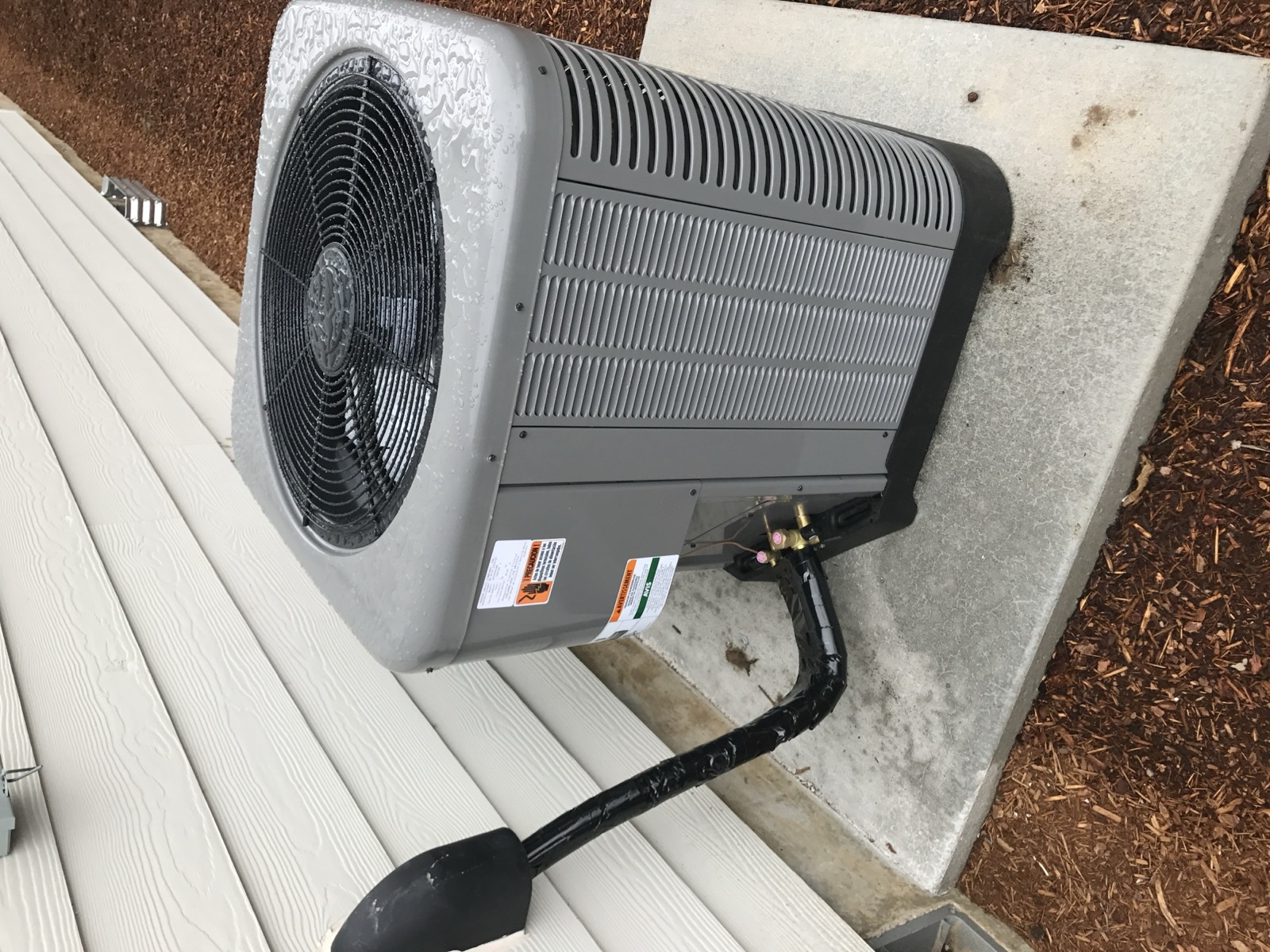
An insulated copper refrigerant line set — foam-wrapped and taped — runs from the furnace out through the exterior wall to a Rheem RA1342AJ1NA, manufactured 11/2016 and set on its pad, brazed and insulated by 2017-06-18. It is original to the build and about 9½ years old. The rating plate gives 3½ tons / 42,000 BTU/h at Rheem’s Classic® series, 13 SEER tier — a base-efficiency unit, notably plainer than the rest of this house’s mechanical package. It runs on R-410A with a factory charge of 105 oz, on a 208/230 V single-phase circuit (minimum ampacity 24 A, maximum breaker 40 A, HACR type required), which reconciles cleanly with the 60 A Siemens WN2060 non-fused pullout disconnect on the siding directly above it — a 60 A switch being the standard code-compliant oversize for a 40 A-max load. That disconnect has no fuses inside it: pulling the block is a purely mechanical on/off action, so if the AC is dead, the fault is at the breaker in the main panel or in the equipment, not inside this box.
The unit sits on its own poured concrete pad, set flush with a bark-mulch bed against the house. Practically, that means bark and blown debris collect against the coil more easily than on a raised pad, which makes the seasonal coil-rinse in Maintenance worth doing on schedule rather than skipping it. As with the furnace, the badge differs from the rest of the system on purpose: the furnace is Ruud, the condenser is Rheem — the same manufacturer under two names, so parts and service are interchangeable.
Which side of the house the condenser is on is not established
Seasonal changeover is just a mode change on the Ecobee (Heat → Cool, or leave it on Auto year-round) — there is no manual damper or valve to move on this single forced-air system serving both.
Whole-house ventilation
A second system lives on the furnace cabinet: a Honeywell Whole House Ventilation Control, screwed to the cabinet face with its status LED lit — powered and running. This is a controlled mechanical fresh-air system, not a smoke detector or a second thermostat. The standard arrangement for this class of control is a dedicated outdoor-air intake duct feeding the furnace’s return plenum through a motorized damper, so the house draws in a metered amount of outdoor air on a schedule instead of relying purely on incidental leakage through the building envelope — a genuine quality detail in a tight, newer-construction house.
The control offers three modes on a slide switch. On / Optimized Ventilation — its current position — lets the control decide when to ventilate, generally avoiding the most extreme outdoor temperatures. Override forces ventilation immediately for a set duration (useful after a party, painting, or heavy cooking). Off / Remote Only disables automatic ventilation and waits for a separate remote or wall control to call for it instead — which implies such a remote may exist somewhere in the house; none has been located. A separate Service indicator lights when the system wants attention.
Still open
- The furnace’s exact model and serial — the rating plate behind the lower access door.
- Whether HeatGuy LLC is still the active service contractor, and the date of the last service.
- A legible close-up of the "Class B Basic Electrical Work" permit tag’s handwritten fields.
- The furnace’s dedicated gas shutoff valve and its breaker in the main panel — identify and label both.
- Which face of the house the AC condenser stands against, and a current photo of it in place.
- Confirmation that the Siemens WN2060 disconnect serves this condenser rather than some other load.
- The whole-house ventilation control’s exact model, off the faceplate at close range or the wiring diagram inside the furnace access panel.
- Where the ventilation system’s outdoor fresh-air intake terminates, and whether a remote or wall control exists for its Override and Off/Remote-Only modes.