02·PLU
Plumbing & Hot Water
A gas tankless water heater and a three-piece water treatment train feed the house — plus the shutoffs, hose bibs, and pressure equipment every owner should be able to find fast.
At a glance
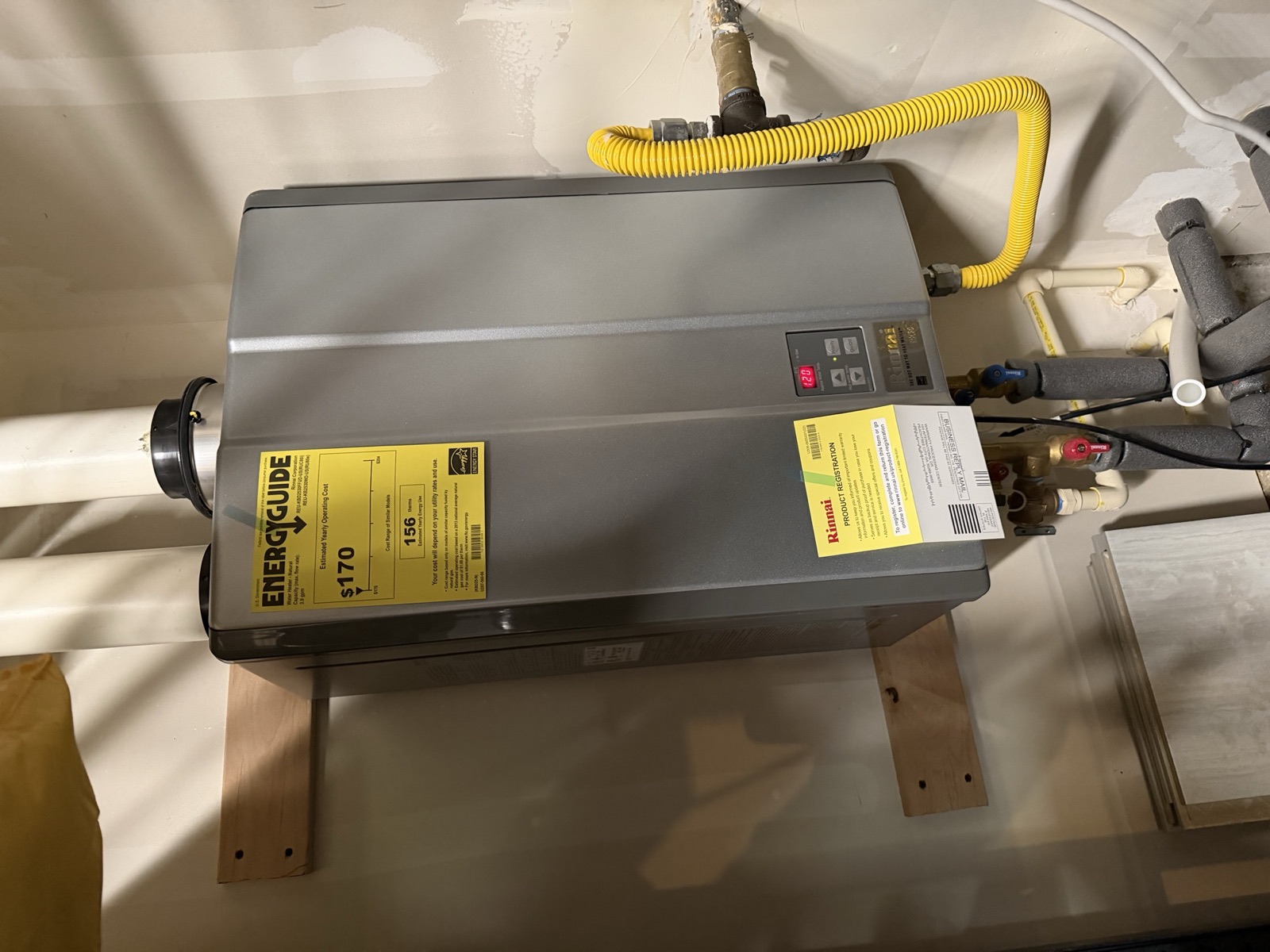
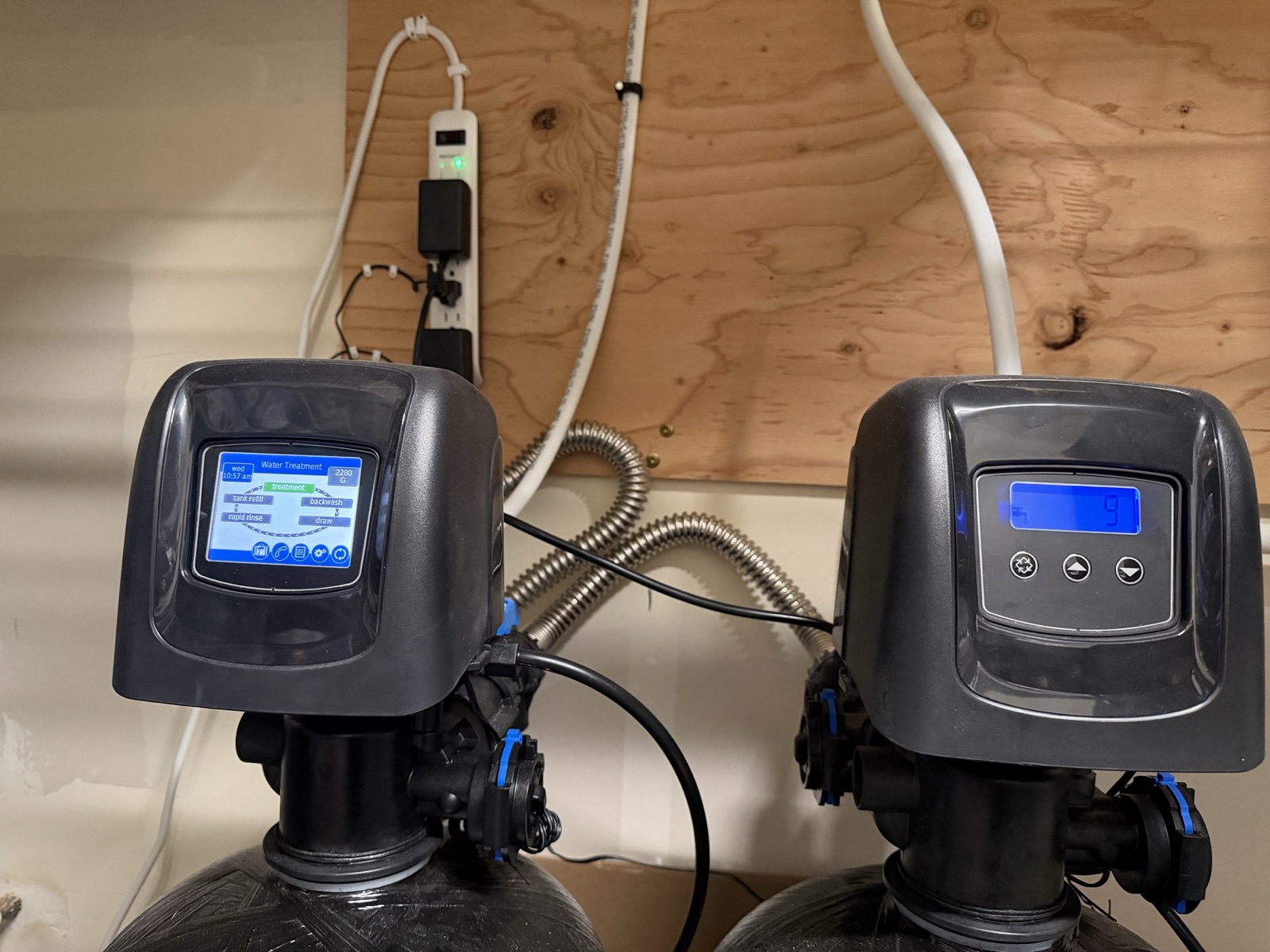
Hot water is produced by a Rinnai RUC80i (retail RUC80iN) indoor condensing tankless gas water heater — there is no storage tank, so hot water is generated as you use it rather than stored and reheated. Ahead of it in the water line is a three-piece water treatment train: a metered water softener, a day-scheduled backwashing filter, and the brine (salt) tank that serves the softener. The two treatment tanks run on Clack WS1 control valves — one with Clack’s colour touch-screen, one with the standard three-button LCD. The train is roughly three times the capacity a family this size needs.
- Where
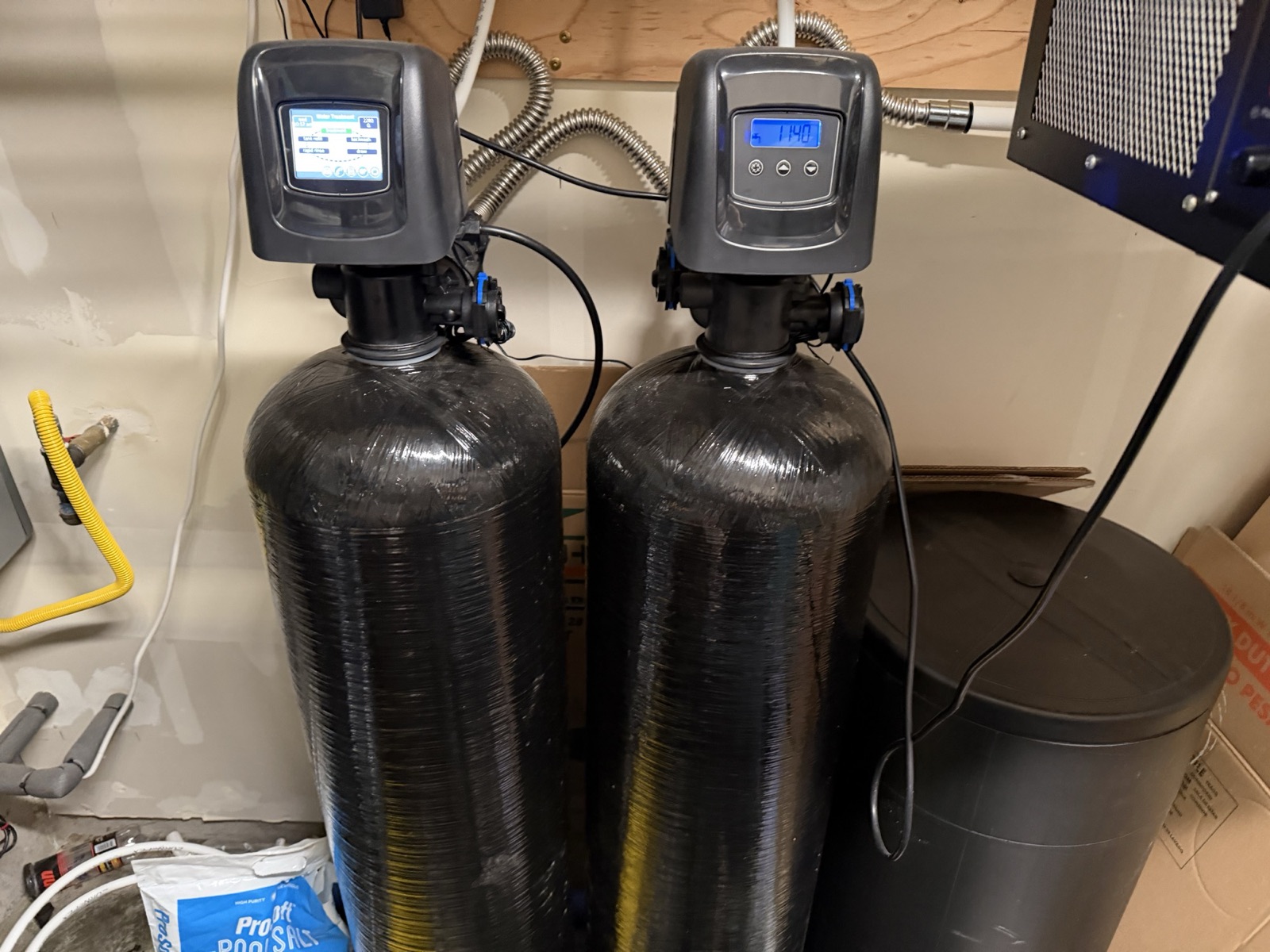
- Everything is in the back bay of the garage. The Rinnai hangs in the southeast corner, on the east wall. The treatment train runs west along the south wall, starting about two feet from the heater — softener, filter, and brine tank in a row, a noticeably wider footprint than the heater’s. One trip to that corner reaches the heater, both tanks, the salt, and every service valve.
- Must know
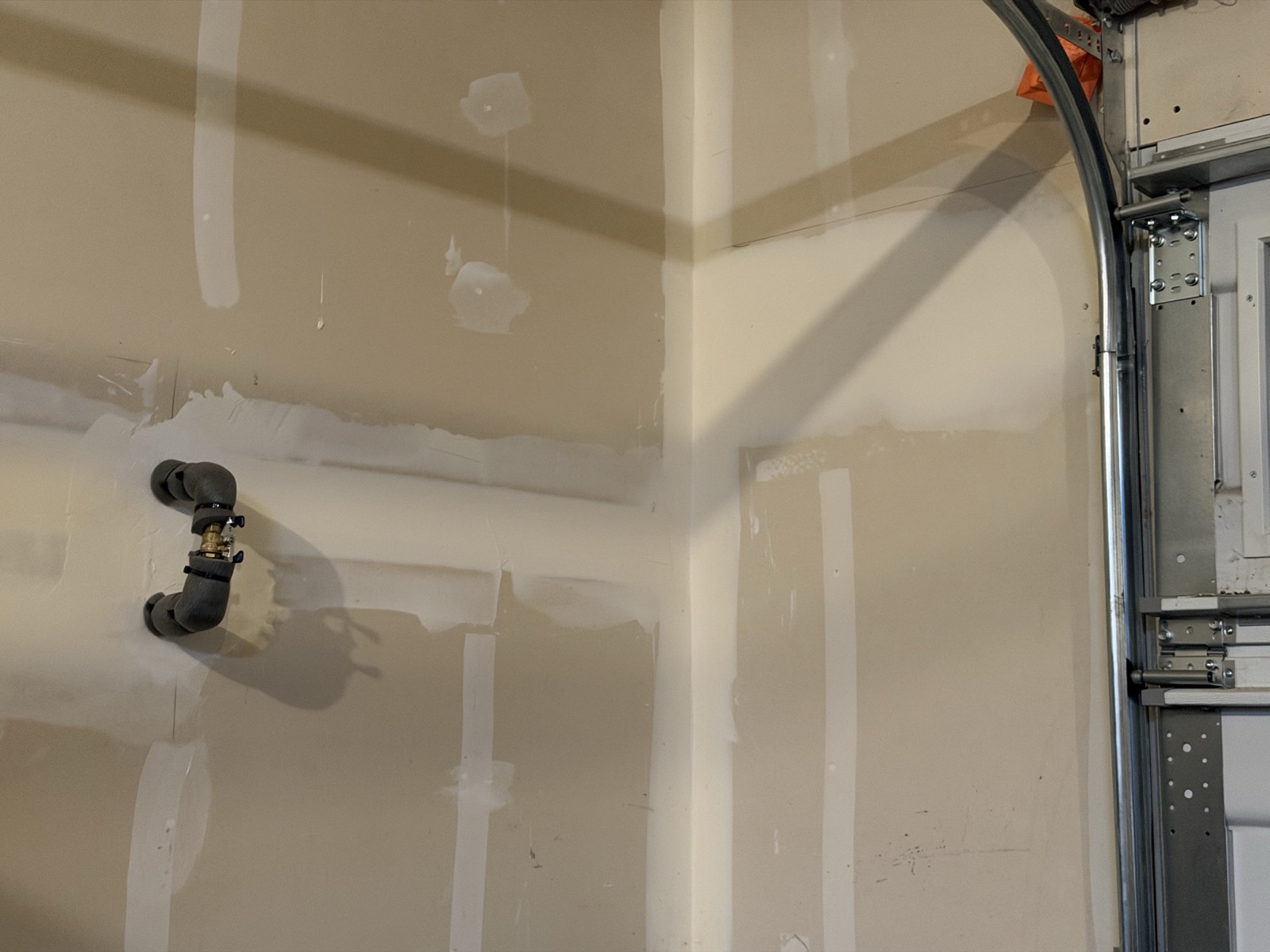
- A tankless heater means you will not run out of hot water — but it also means no power or gas = no hot water, instantly, with no tank reserve to draw down. The main water shutoff is on the garage’s south wall, right beside the overhead vehicle door, about 5½–6 feet up: a brass lever ball valve, quarter-turn.
- Status
- Original to the 2017 build, in service, and never the subject of a failure or a repair. Several identity details — the heater’s serial, the filter’s media, the system’s assembler — are still open; see the to-confirm chips below.
2Everyday use
Day to day, this system asks nothing of you. Hot water is simply always available, and the softener and filter run themselves.
- Hot water: just open the tap. The tankless unit fires on demand and delivers a steady temperature for as long as you run water — there’s no tank to “run out” and then deliver a cold surprise mid-shower, which is the main everyday difference from a tank-style heater.
- Water softener: runs automatically, metered by water use. The only thing it ever asks of you is salt in the brine tank — see Maintenance.
- Filter: also automatic, and on a day-based schedule rather than a water meter — its display counts down the days to its next backwash. It asks nothing of you day to day. To confirm: which media it holds, and therefore what it treats for — see Specs.
- Brine (salt) tank: the wide drum at the end of the row. This is the one you pour salt into, and the only part of the whole train with a routine.
Endless hot water, with one caveat
Finding it all in the garage
3Maintenance
Annual descaling is not optional for a tankless heater
- Tankless heater — annual flush/descale: using the installed isolation/flush valve kit, a licensed plumber (or a confident DIYer with a descaling pump kit) flushes the unit once a year. Budget this as a recurring line item.
- Tankless heater — inlet water filter: the RUC80i has a small inline screen filter on the cold-water inlet; check and clean it at the same time as the annual flush.
- Softener — resin bed: the resin media inside the softener tank typically lasts 10–15 years before it needs replacing; not a near-term concern for a 2017 install, but worth a line on the maintenance calendar.
- Filter — media, not a cartridge: this is a backwashing media tank on a timer, not a screw-in cartridge housing. There is nothing to unscrew and change monthly; it flushes itself to drain and its media is changed out by a technician at long intervals. To confirm which media it holds — that determines the change-out horizon.
Salt, hardness, and service — scale these to how much water the house actually uses
| Household | Check / refill salt | Tap hardness test | Professional service |
|---|---|---|---|
| 2–3 people (typical for this house) | Look every 2 months; expect to actually add salt roughly 2–3×/year | Every 6 months | Every 12–18 months |
| 4–5 people | Look monthly; expect to add salt roughly 4–6×/year | Every 3–4 months | Annually |
| Heavy entertaining / full house (~8–10) | Look monthly and before any stretch of guests; expect to add salt monthly-ish while occupied | Every 2–3 months | Annually |
| Away / vacant for months | Top up before leaving; check for salt bridging on return | On return, before assuming it still works | Before returning to full-time use after a year idle |
How to read that table: the tasks and the 12–18-month professional-service interval are standard water-treatment industry guidance (see Documents). The split across household sizes is reasoned from this system’s sizing plus ordinary per-person water use — deliberately conservative (check more often than you will need to act), and not a manufacturer schedule for this specific train. Once the assembler is identified (see Specs), their programming card supersedes it: that card states the actual salt dose per regeneration and the grain capacity these intervals are really a function of.
- What salt to buy: salt nuggets — a coarse-pellet softener salt, sold in yellow bags at Home Depot (Lowe’s and any farm/hardware store carry the equivalent). Nuggets suit this kind of system well; avoid rock salt, which leaves more insoluble residue in the brine well. Exact brand/product name to confirm.
- How to add it: lift the brine-tank lid and pour. Keep the tank between roughly one-third and two-thirds full — filling it to the brim in an oversized, slow-cycling system just gives the salt longer to cake.
- Salt bridging: watch for a hard crust forming above the water line inside the brine tank, which hides an apparently-full but actually-empty reservoir. It is more likely in a lightly-used, oversized system precisely because the salt sits undisturbed for longer — break any crust up with a broom handle. This is the most likely way soft water quietly stops in this particular house.
- A quick sanity check any time: the touch-screen head’s home screen shows gallons remaining. If that number never moves between two visits weeks apart, the meter or the bypass wants looking at.
Winter freeze protection
4Troubleshooting
- No hot water at all: check that the unit has power (it needs electricity even though it burns gas — the igniter, control board, and fan are electric) and that the gas valve to the unit is open. If both are fine, check the digital control panel on the front of the unit for an error code.
- Hot water comes and goes / temperature swings: can indicate the flow rate is below the unit’s minimum-activation threshold (e.g., a very low-flow faucet), a partially clogged inlet filter, or scale buildup — start with the inlet filter, then consider whether the annual descale is overdue.
- Water is hard unexpectedly: if soap stops lathering and spots return on glassware, the softener is most likely out of salt or bridged. Check the brine tank first, then the bypass valve position, then call for service.
- Visible mineral buildup on fixtures despite the softener: same three checks — salt, bridging, bypass — before calling a pro.
- Any active water leak: stop reading and go to the main shutoff — garage south wall, beside the overhead vehicle door. Then follow the Water leak runbook.
5Specs & identity
| Brand / model | Rinnai RUC80i, retail SKU RUC80iN (natural gas). Full factory model string REU-KBD2530FFUD-US-N — the string Rinnai tech support and parts diagrams use. The EnergyGuide label reads REU-KBD2530FFUD-US(RUC80i) with (KBD25-N) for the natural-gas variant; the front badge is embossed RUC80. |
|---|---|
| Type | Indoor, natural-gas-fired, condensing tankless (on-demand) water heater — Rinnai’s Ultra Series super-high-efficiency line, vented with a concentric collar, with a condensate drain |
| Capacity | 152,000 BTU/H (modulating range 15,200–152,000 BTU/h), flow rate 0.4–8.0 GPM — 0.4 GPM is the minimum activation flow, the practically important number, since below it the unit won’t fire. UEF 0.92, ENERGY STAR qualified. (The EnergyGuide label’s "3.9 gpm" is the standardized DOE test-condition figure at a ~70°F rise, not the unit’s real-world maximum flow — worth knowing so this doesn’t read as a 3.9 gpm heater.) |
| Compatible temperature controllers | MC-91-2, MC-100V, BC-100V, MCC-91-2 — the list needed to add or replace a wall temperature controller. Whether one is installed on a wall somewhere — to confirm. |
| Serial number | owner's edition |
| Current temperature setpoint | Set to 120°F |
| Age | Original to the 2017 build — delivered to the job site 2017-06-18 and installed by 2017-07-13. It has never failed or needed a repair. |
| Location | Garage back bay, southeast corner — wall-hung on the EAST wall, right in the corner |
| Gas shutoff (unit) | A yellow CSST gas line with a black-iron drop and a shutoff enters the same wall — confirm its exact position for quick shutoff |
| Isolation/service valves | Rinnai isolation/flush valve kit installed (red/blue-handled service valves with flush ports) — the unit can be descaled and flushed without a plumber cutting pipe |
| Location | Garage back bay, along the SOUTH wall, starting about two feet from the water heater and running west from there |
|---|---|
| Footprint | Noticeably larger than the water heater’s — the three pieces together occupy several feet of wall, and the brine tank is the widest of them. Plan for that when arranging the back bay: this is not a small setup tucked into a corner. |
| The three pieces, in order | 1 — Softener (tall black composite tank, colour touch-screen head) · 2 — Filter (matching tank, three-button LCD head) · 3 — Brine/salt tank (the wide drum with a removable lid, where the salt goes) |
| Control valves | Clack Water Specialist WS1 on both treatment tanks, identified by the WS1 body geometry and Clack’s blue locking clips on the inlet/outlet, drain and bypass fittings. Clack makes the valve and sells to hundreds of OEM assemblers, so this identifies the mechanism, not the brand of the finished system. |
| Shared power | Both control heads run from a shared surge-protected power strip on the plywood equipment backer, not dedicated receptacles — if that strip is switched off or trips, both valves lose their programmed clock |
| Sizing | Roughly 3× the capacity a family this size needs — which is what the two tall tanks and the very slow salt consumption reflect. This is why Maintenance above is a usage table rather than a single cadence. |
| Bypass valve (whole-system) | Blue Clack bypass clips are present on both valve bodies, but no separate labelled whole-train bypass handle is visible — to do: locate and label it |
| What it does | Removes the calcium and magnesium that cause hardness, by ion exchange across a resin bed (see Technical reference). This is what keeps scale out of the tankless heater, the dishwasher, and the fixtures, and what makes soap lather the way it does here. |
|---|---|
| Control | Clack WS1 with Clack’s colour touch-screen electronics package, running metered / demand-initiated regeneration. Its home screen shows a system-name banner, a day/time tile, a gallons-remaining tile, a green treatment (service) state, and the WS1 regeneration ring: treatment → backwash → draw → rapid rinse → tank refill. |
| Consumable | Softener salt — but it goes into the brine tank, not into this tank. Nothing is ever added to the softener vessel itself. |
| Service item | Resin bed, 10–15 year typical life |
| Reading at last inspection | 2280 gallons remaining, clock correct, in normal service mode — a point-in-time reading, not a fixed spec |
| What it does | A backwashing media filter — water passes down through a bed of filtration media, and on a schedule the valve reverses flow to lift and rinse the bed to drain. It is the polishing stage ahead of (or behind) the softener, and it has no brine supply of its own. |
|---|---|
| Control | Clack WS1 with the standard three-button, blue-backlit LCD head on a day-based (time-clock) program. The display toggles between time of day and days until the next backwash — a bare number on that screen is a day count, not a flow rate. |
| Consumable | The media bed itself, changed out by a technician at multi-year intervals. There is no screw-in cartridge on this unit and nothing for an owner to replace month to month; the recurring cost is the service visit, and a water-treatment dealer supplies the media. Media type to confirm — carbon (taste/odour), sediment, or iron/manganese — which is what sets the change-out horizon. |
| Where to buy | Media change-out is a dealer/service-call item rather than a shelf purchase. Any local water-treatment company that services Clack WS1 valves can do it; identifying the original assembler (below) gets the exact media and programming card. |
| What it does | Holds the salt and the brine solution the softener draws on to recharge its resin. This is the only piece of the train with a routine, and the only one you ever open. |
|---|---|
| Consumable | Salt nuggets — coarse-pellet softener salt, yellow bag, Home Depot. Exact brand/product name to confirm. |
| How much | Keep the tank roughly one-third to two-thirds full. At this train’s sizing, a two-to-three-person household adds salt only about 2–3 times a year — see the usage table in Maintenance. |
| Watch for | Salt bridging — a hard crust above the water line that makes an empty tank look full. Break it up with a broom handle. |
| Assembler / dealer brand | Open. The tanks are unbranded black composite vessels; the only label on either is a small two-column sticker low on the filter tank, illegible at present and, by its layout, a vessel pressure-rating plate rather than a dealer decal. The touch-screen’s system-name banner — the field an assembler would brand — reads a generic "Water Treatment". See the callout below for the fastest way to settle it. |
|---|---|
| Dealer / installer / service contract | Open. The touch-screen head almost certainly holds the answer — see the callout below. |
How to identify this system in ten seconds — tap the telephone icon
If the dealer screen is blank or was never programmed, the fallbacks, in order: (1) a straight-on macro of the small white label low on the filter tank — the vessel rating plate, which at least gives tank make and size; (2) look under the brine-tank lid and on the brine well for an installer sticker; (3) the 2017 build file, or the salt supplier. Do not expect the tanks themselves to carry a brand: they are deliberately plain, and the assembler left the touch-screen’s name banner generic.
| Model | Gerber Viper, model VP-28-5xx, 12" rough-in. The 12" rough-in dimension is the number needed to source or replace a toilet in this house; the Viper line is a two-piece, 1.28/1.6 gpf toilet. |
|---|---|
| Coverage | To confirm whether every bathroom got this model — the delivery was a single pallet, which suggests so, but it has not been checked room by room. |
| Main water shutoff | Garage, south wall, right beside the overhead vehicle door, about 5½–6 feet up — a brass lever-handled ball valve (quarter-turn, no packing nut to fight) on an insulated riser. See the photo below. |
|---|---|
| Water pressure regulator (PRV) | To confirm whether one is installed (common where municipal pressure is high); typically near the main shutoff at the point water enters the house |
| Sewer cleanout | To confirm location — typically a capped pipe near the foundation or in the yard along the sewer line’s path to the street |
| Under-sink shutoffs | Every sink, toilet, and the dishwasher and fridge icemaker has its own local shutoff. To confirm all are operable — a valve that hasn’t been turned in years can seize; exercising them occasionally is worth doing |
| Hose bibs | Exterior spigots around the house — winterization steps (shutoff, drain, disconnect hoses before frost) are on the Irrigation & Exterior Systems page, not duplicated here |
|---|---|
| Irrigation backflow preventer | A Zurn Wilkins 1" model 850 double-check valve assembly (DCVA), below grade in its own valve box with its own isolation ball valves, protects the drinking water from the irrigation lines. That is the irrigation system’s backflow device, separate from anything on this page — full detail, photo, and the annual test requirement are on Irrigation & Exterior Water. |
6Documents & links
The heater’s manuals are archived against its exact model. The treatment train’s valves are Clack WS1, so the Clack references below are valve-level documentation; they will be replaced with the assembler’s own manual and programming card once that company is named.
- Rinnai RUC80iN (KBD2530FFUD-US) — owner’s manual (PDF)
Official Rinnai asset CDN — 142 pp, covering the KBD2530FFUD-US platform (N/P suffix = gas type; one manual serves both). Exact match for this unit. - Rinnai — RUC80i (REU-KBD2530FFUD-US) official spec sheet (PDF)
Manufacturer spec sheet for this exact model — BTU range, flow rates, UEF, and dimensions. - Rinnai — Professional document library (manual lookup)
Search by product type/document type; use to pull any additional Rinnai literature for local archiving. - Clack Corporation — WS1 control valve
Official page for the valve family on both treatment tanks — describes the WS1 regeneration cycle stages shown on the touch-screen head. - Clack WS1 control valve (3-button LCD head) — drawings & service manual (PDF)
Official clackcorp.com, 48 pp — the head on the filter tank. Series-level documentation (valve family, not the assembled system). - Clack WS1CS control valve (colour touchscreen head) — programming manual (PDF)
Official clackcorp.com — the head on the softener. Series-level documentation. - Clack — WS1TC / WS1.25TC time-clock operation & instruction manual (PDF)
The time-clock programming behind the filter’s day countdown: a WS1 time-clock head toggles between time of day and days until the next regeneration. Generic Clack documentation. - Clack touch-screen electronics — OEM spec sheet (via Charger Water) (PDF)
Documents the touch-screen package Clack supplies to assemblers, including the "dealer contact screen (dealer logo insert option)" behind the telephone icon on the softener head. Charger is one assembler among many, cited for the option, not as this system’s brand. - Water Quality Association — How water softeners work
Independent trade-association explainer on ion-exchange softening, salt, and regeneration. - EPA — Well & plumbing shutoff basics (general)
General reference; the house is on municipal service, but shutoff and valve fundamentals are the same.
Section 8Technical reference ExpandCollapse
The engineering layer — for a buyer's technician, or a curious owner.
Tankless vs. tank, briefly: a tank water heater keeps 40–80 gallons hot and ready at all times, reheating as it’s drawn down — simple, but it can run out under heavy simultaneous use and wastes some energy keeping stored water hot around the clock (standby loss). A tankless unit has no reservoir: a flow sensor detects water movement, fires the burner, and a heat exchanger brings the water to temperature in the few seconds it takes to pass through — so it never “runs out,” uses no energy when idle, but its output is capped by a maximum flow rate rather than a stored volume. That flow-rate ceiling is why running several high-demand fixtures at once (two showers plus a washing machine, say) is the practical limit to be aware of, not “running out of hot water” in the tank sense.
Softening — ion exchange, briefly: a salt-based softener passes hard water through a resin bed charged with sodium ions; the resin swaps out the calcium and magnesium ions that cause hardness for sodium ions, which don’t form scale. Once the resin’s capacity is used up — tracked here by a metered Clack WS1 valve, i.e. by water use rather than a fixed clock — the valve triggers a regeneration cycle, flushing the resin with brine drawn from the brine tank to recharge it and washing the displaced hardness minerals to drain. The gallons-remaining figure on the touch-screen is literally the countdown to that event.
Backwashing filtration, briefly: the second tank works on a different principle. Water passes down through a media bed that traps what it is designed to trap; on its day-based schedule, the valve reverses the flow to lift, scour and rinse that bed to drain, which is why the tank needs a drain line but no brine supply. Nothing is consumed on each cycle except a tank of rinse water, and the media is replaced only after years of service. Because the media is inside a sealed vessel, which media it is remains an open item: carbon (taste and odour), sediment, or iron/manganese are the ordinary residential possibilities, and they differ in change-out interval rather than in how the tank behaves.
Why the brand of the finished system is unknown. Clack sells its valves to hundreds of OEM assemblers who build them onto their own tanks and sell under their own names, so a Clack head identifies the mechanism and says nothing about who assembled the train. Everything an assembler would normally brand is blank here: the tanks are plain black composite vessels; the only sticker is a small two-column label low on the filter tank, in the shape of a vessel pressure-rating plate rather than a dealer decal; and the touch-screen’s system-name banner, which an assembler can set to its own product name, reads the factory-generic "Water Treatment". The components are identified; the brand of the finished system is not, and the telephone icon on the softener’s home screen is the one thing that will settle it without a single label. See the callout in Specs.
What the house is plumbed with. The potable supply runs in PEX — orange hot and blue cold homerun tubing — with blue-handled quarter-turn stop valves at each stub-out, and drainage is ABS/PVC. That matters for two ordinary reasons: PEX is not polybutylene (a common inspection-anxiety question on an older house, moot here), and quarter-turn stops mean every fixture shutoff should operate with a simple twist rather than the many turns — and eventual seizing — of an older multi-turn compression stop.
Oversizing, and what it changes. The train is around three times what a household this size needs. Oversizing a softener is not like oversizing a furnace — a softener that is too large does not cycle badly or waste energy; it simply travels further between regenerations, using less salt and less regeneration water per gallon of soft water delivered, and holding a large reserve for a house full of guests. The trade-offs are real but mild: more up-front cost and floor space, water sitting longer in the resin bed during light use, and — the one that actually bites — a maintenance rhythm slow enough to forget. A right-sized softener in a busy house reminds you it exists every few weeks when the salt runs low; this one may not remind you for a season. That is the whole reason Maintenance is a usage table with a "look at it every N months" column rather than a single line item.
Still open on this page: the touch-screen’s dealer information screen (the highest-value single item here); the tankless heater’s serial number, on its underside rating plate; the filter’s media, and therefore what it treats for; a legible macro of the vessel label low on the filter tank; the whole-train bypass handle, located and labelled; the exact salt product name; whether a pressure-reducing valve is installed and at what setting; the sewer cleanout location; a function check of every under-sink shutoff; and whether every bathroom’s toilet is the same Gerber Viper model.