02·IRR
Irrigation & Exterior Water
A WiFi-connected Rachio controller runs the sprinklers; a backflow preventer protects the drinking water; hose bibs and gutters round out the exterior water picture.
At a glance
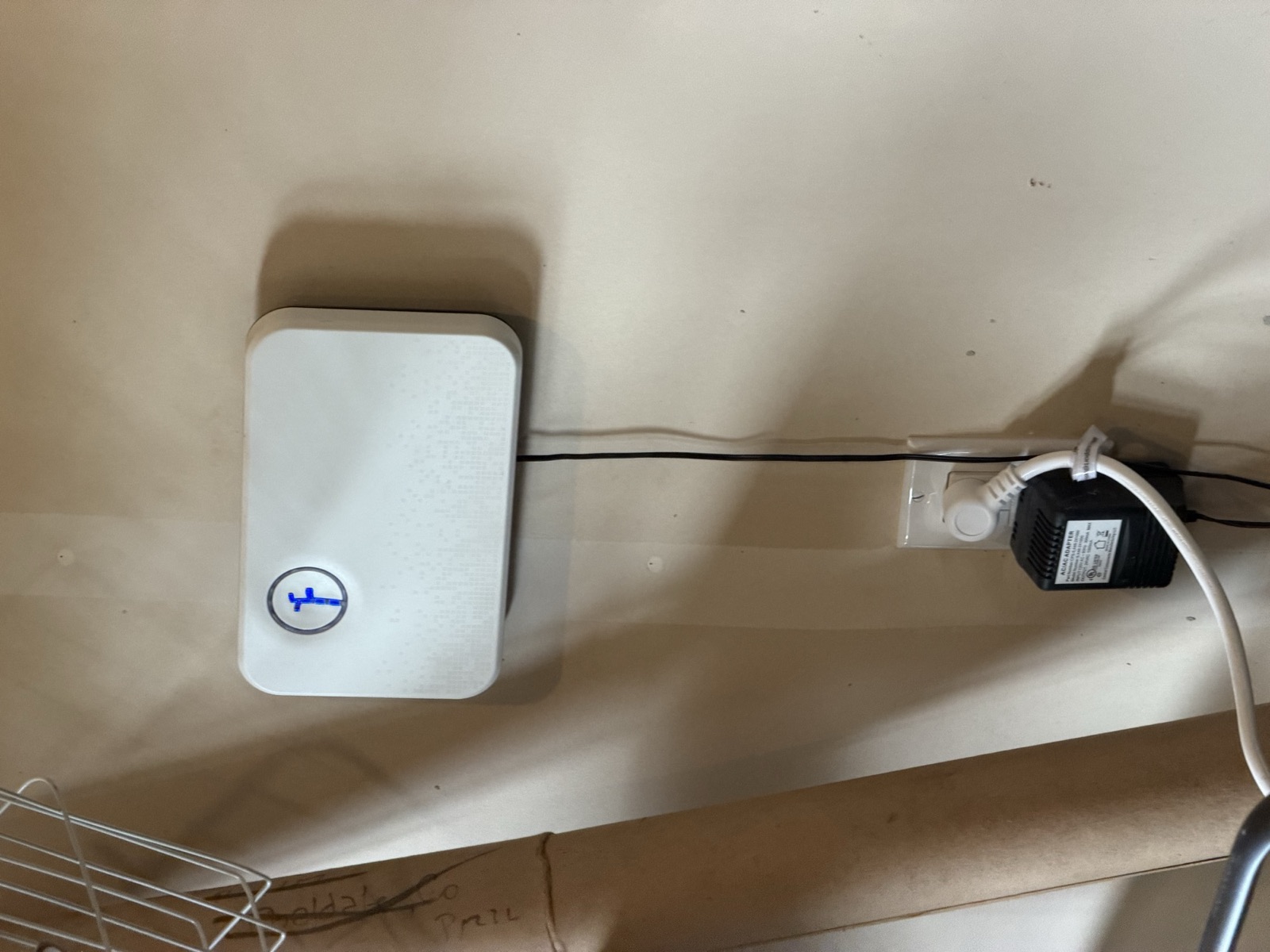
A wall-mounted Rachio smart sprinkler controller — likely Gen 2, to confirm — runs the yard’s 3 irrigation zones (front lawn, back lawn, and a dedicated drip zone) on a schedule, and automatically skips watering around rain, wind, and freezing weather using local weather data. The drip zone alone covers all the raised beds, the full bed along the north fence, the run along the east fence, and the south-side bar area — a genuinely extensive drip system for a residential lot. A backflow preventer protects the house’s drinking water from anything in the irrigation lines.
- Where
- Controller: in the garage, on the north wall near the front — immediately the other side of a shelving unit from the Tesla Wall Connector, and close to the main electrical service just outside that same wall (see the Garage page). It is plugged into a standard duplex receptacle via a 24VAC transformer rather than hardwired, so it can be unplugged without an electrician. Head end: two adjacent below-grade valve boxes — backflow preventer and 3-zone solenoid manifold — in a trench along the house’s foundation stem wall. The drip line branches in a separate access box in the gravel just off the patio concrete.
- Must know
- The annual winterizing is not your job. The HOA’s landscaping company blows out the lines and shuts the water off for the entire HOA every year, and manages the whole front area. What you own is the back yard irrigation and any repairs to broken equipment — the procedure below is kept for reference and for breakages, not as a chore on your calendar. Washington state and Ridgefield municipal code require the backflow preventer to be tested annually by a certified tester. A large inventory of spare drip-irrigation parts stays with the house — enough to outfit two or three houses.
- Status
- Installed and operating. Three zones: front lawn, back lawn, drip. Controller generation is narrowed to likely Gen 2 from the front panel and is still to settle outright, and which physical zone number (1/2/3) matches which zone remains unmapped.
2Everyday use
Day to day, irrigation should run itself. The two things you’ll actually touch are the Rachio app (to check on it or override it) and, a couple of times a year, a hose bib. The autumn blow-out that usually sits at the top of an irrigation page is, here, someone else’s job — see below.
The HOA winterizes the system — and manages the whole front area
Everything lives in the Rachio app (iOS/Android) and at rachio.com. There is no meaningful way to run this system as a “dumb” controller from the front panel — the app is the point, and it is where the zone names, the schedules and the watering history for this garden live.
- Open the app or rachio.com — you don’t need to be standing at the controller for anything.
- The Home tab shows what’s scheduled next and whether a skip is in effect (rain/wind/freeze).
- To run a zone right now (e.g. to check a head, or water a spot that looks dry), use Quick Run: pick the zone(s), set a duration, and go.
- To change how often things water, edit the schedule for a zone or group of zones rather than fighting the controller manually every week.
Weather-based skipping
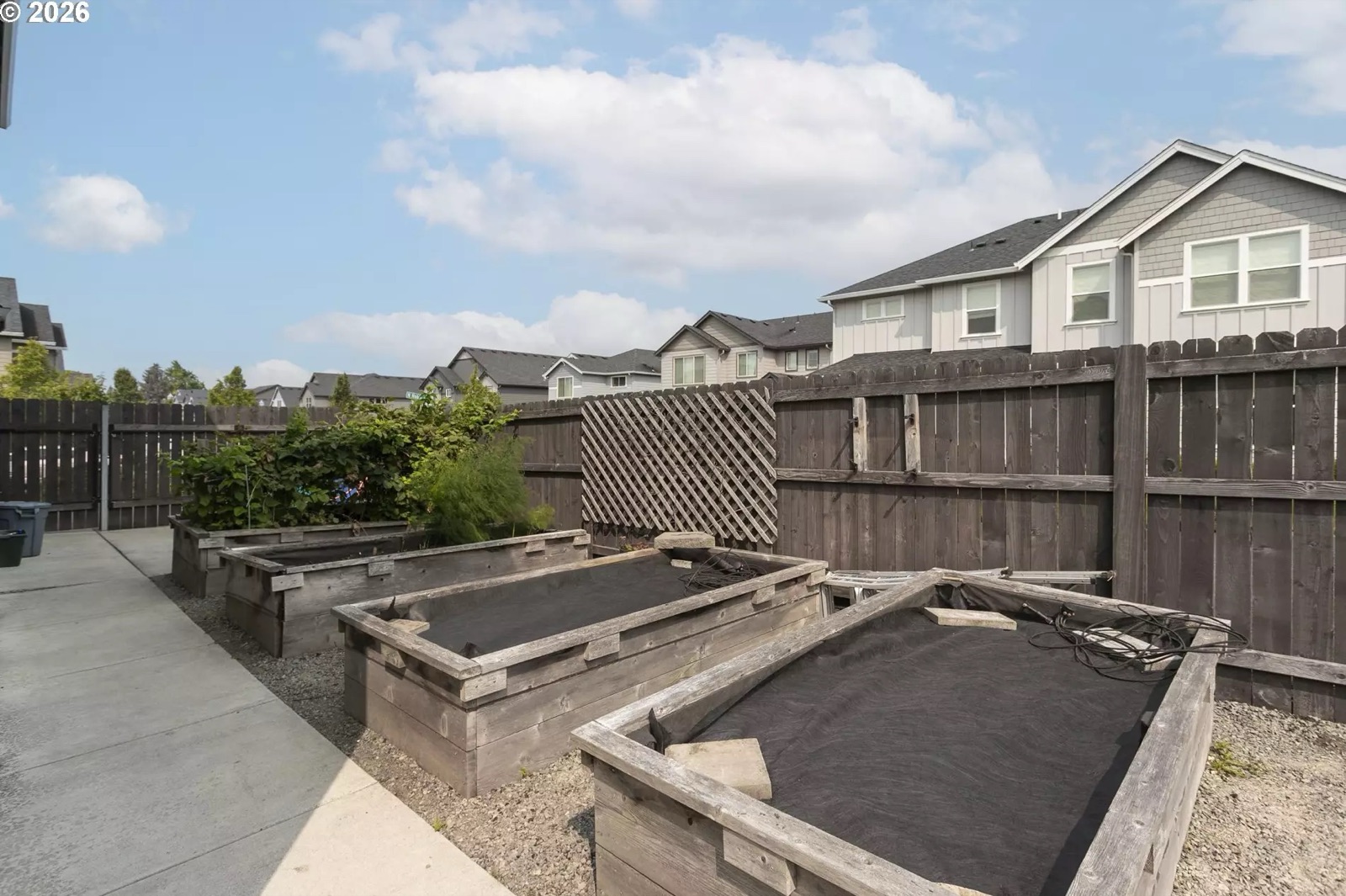
A genuinely extensive drip system
Where the drip line splits — the access box off the patio
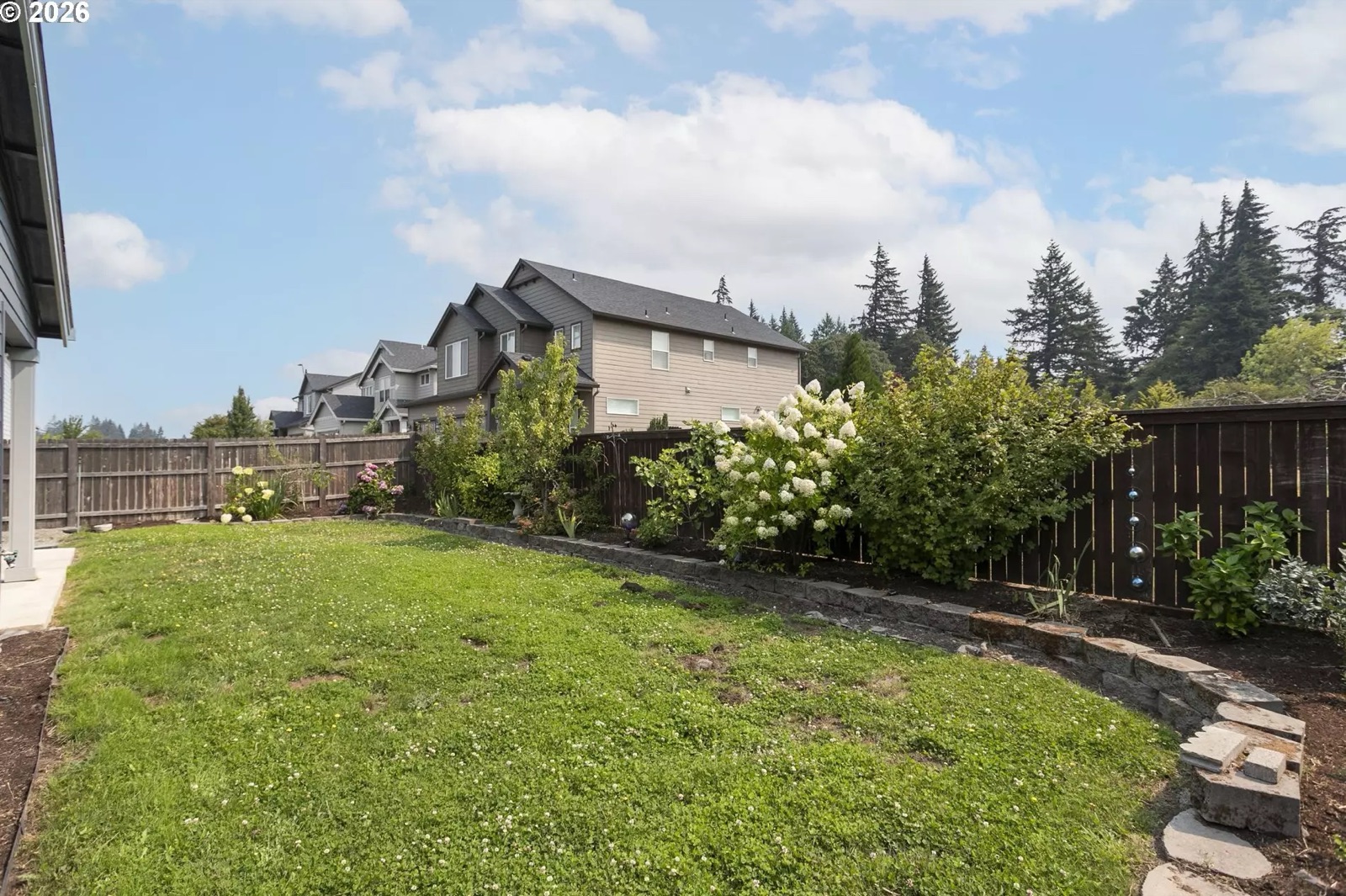
The vegetable garden, fruit trees, and berry bushes are largely on that drip zone rather than an uncontrolled watering-can rhythm, but it's still worth checking soil moisture by hand rather than assuming the schedule alone is enough — especially for containers and raised beds, which dry out faster than lawn. A full planting map (what’s in which bed, sun/water needs) is to gather; a dedicated landscaping page may follow later, but isn’t part of this page.
3Maintenance
The annual blow-out is the HOA’s, not yours
Fall winterization — for reference
- The method is a professional blow-out with compressed air — the standard Pacific Northwest irrigation-company service, typically 60 PSI through the mainline with each zone opened in turn. It needs equipment most homeowners don’t have, which is part of why having it come with the HOA is worth as much as it is.
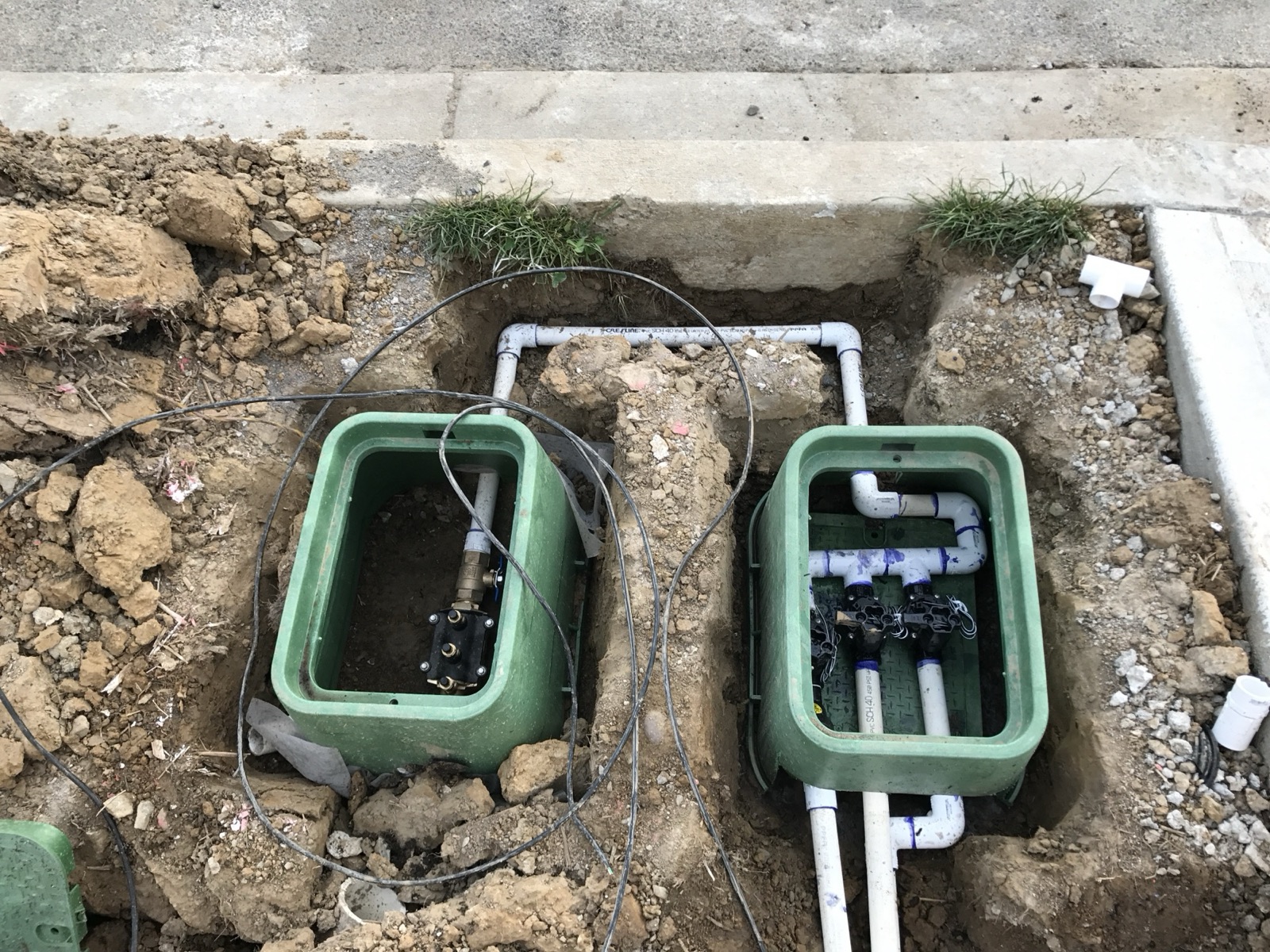
- The shutoff is the isolation ball valve above the backflow assembly in the left valve box (photo above); each zone is then run in sequence from the Rachio app while compressed air clears the lines, a few passes per zone until no more water sprays from the heads.
- Rachio controllers have a built-in Freeze Skip that pauses watering below a set temperature threshold year-round. It is not a substitute for a blow-out — it stops the controller starting a cycle in a freeze; it does not drain the lines.
- Backflow preventer: this assembly is below grade in its own valve box, not on an exposed above-ground riser, which gives it some inherent freeze protection — but an open box lid still exposes it to cold air pooling inside. Draining it is part of the blow-out; foam insulation or a floating cover in the box is cheap extra protection in a hard freeze.
- What is still worth doing yourself: before the first freeze, disconnect the hoses (see below) and confirm with the HOA when the contractor is coming, so you are not running the back-yard drip system the week after it was drained.
Spring startup — also the HOA’s
- The water comes back on with the same HOA service that turned it off, so the first sign of spring on this system is usually that it simply starts working again.
- Worth doing anyway, once: run each zone with Quick Run and walk the yard, checking every head for clogs, broken risers, or misalignment from winter freeze/thaw and any yard work. Broken equipment is the homeowner’s to fix, so this walk is the one that saves money.
- Confirm any schedule you paused is re-enabled and that Weather Intelligence skip settings are as you want them for the growing season.
Backflow preventer testing — annual, and required by law here
Washington State requires backflow prevention assemblies to be tested annually by a WA-certified backflow assembly tester (WAC 246-290-490). The City of Ridgefield's own code requires the same — annual testing under Ridgefield Municipal Code §13.55, with the Public Works Department sending a courtesy reminder letter roughly 45 days before the test is due each year (its notification cycle runs April–September). Confirm this house's water provider (City of Ridgefield vs. another purveyor) and whether a backflow assembly is already registered with them — see Documents for the official sources.
- Sprinkler heads: once or twice a season, walk the yard during a Quick Run and check for heads that are sunken, tilted, clogged, or spraying the driveway/siding instead of the lawn — clean or straighten as needed.
- Drip zone emitters: the drip zone (raised beds, north-fence bed, east fence, south bar area) has more individual emitters and fittings than a spray zone, so it's worth a slower seasonal walk — check for a clogged, popped-off, or leaking emitter at each plant, and for tubing damaged by weeding, mulching, or freeze/thaw.
- Hose bibs: before the first freeze, disconnect hoses (a hose left attached traps water in the bib and defeats frost-proof designs), and if any bib is not a frost-proof/freeze-proof type, shut off its interior supply valve and drain it for winter.
Spare drip-irrigation parts stay with the house — a large inventory
4Troubleshooting
- A zone won’t run: confirm the controller itself is online first (see below) — if it is, check that the main irrigation water supply and any backflow-preventer shutoff valves are fully open, then check that zone’s wiring at the controller against the others (Rachio’s app flags a “zone fault” when it detects an electrical short or open circuit on a zone’s wire).
- Controller shows offline in the app: power-cycle it — the controller is in the garage, on the north wall near the front, a step from the EV charger; unplug its transformer at the receptacle, wait, plug back in. Confirm the home WiFi is on the 2.4 GHz band — Rachio controllers generally don’t support 5 GHz-only networks. If the network name or password has changed, a power cycle won’t help: the controller has to be pointed at the new network through the app’s device settings. If the whole house network is down, fix that first (see the Network page).
- App says a zone is running but no water comes out: that’s consistent with the water supply or backflow shutoff being closed, a solenoid valve failure, or a wiring fault rather than a controller problem — Rachio’s official “Zone Not Activating” guidance walks through isolating which of those it is. If the water was shut off for the winter by the HOA’s contractor and has not been turned back on yet, this is exactly what you would see.
- Part of the drip system is dry and the rest is fine: open the access box in the gravel just off the patio concrete. That is where the drip line splits into its two legs — one to the raised beds, one to the north and east plantings — so the fault is usually on one side of that split, and the split is the fastest place to prove which.
- Low pressure or weak spray at some heads: often a clogged nozzle/filter or a partially closed backflow/isolation valve rather than the controller; check the valve is fully open before assuming a head is bad.
The app diagnoses itself
5Specs & identity
| Type | WiFi-connected smart sprinkler controller (Rachio) |
|---|---|
| Generation | Likely Gen 2, to confirm. The unit’s face is uniform white with exactly one round illuminated button at the lower left, and shows no full-width translucent light bar and no Run/Pause/Skip button cluster next to the logo — the Rachio 3 (Gen 3) has both of those on its visible front face, so their absence here points toward Generation 2. It is powered via a plug-in 24VAC transformer rather than a hardwired junction, which fits either generation and isn’t a discriminator. Confirm at walkthrough by opening the front cover for a model/FCC ID label, or checking the Rachio app’s device info. |
| Installed location | Garage, north wall, near the front. Wall-mounted immediately the other side of a shelving unit from the Tesla Wall Connector, and close to the main electrical service on the outside of that same wall (see the Garage page). Powered from a nearby duplex receptacle through a plug-in 24VAC transformer, so it can be unplugged without an electrician. |
| Number of zones | 3: front lawn, back lawn, and a dedicated drip zone |
| Who maintains what | The HOA’s landscaping company winterizes the system for the whole HOA each year and manages the front area. The homeowner owns the back-yard irrigation and repairs to broken equipment. |
| Conveys with the house | Yes — included with no exception, along with the large spare-parts inventory |
| Zone map (which controller number is which) | To confirm — what the 3 zones water is settled (see the zone table below), but which physical zone number (1, 2, or 3) on the Rachio controller/app corresponds to each one is still to check against the app or the valve wiring. |
Owner's edition
Full details in the owner's edition — serial numbers, configuration and identity details continue in the complete manual, handed to the buyer at closing.
| Backflow preventer | A Zurn Wilkins 1" model 850 double-check valve assembly (DCVA), below grade in its own green valve box, with upstream/downstream Zurn 400 PSI ball-valve isolation above and below the DCVA body — irrigation can be isolated at this box without touching the house’s main water shutoff. Installed 2017-05-26. A DCVA does not vent to atmosphere the way an above-ground PVB does, which is why it can sit below grade — but it is also freeze-vulnerable in an open box, which is why the annual blow-out matters. |
|---|---|
| Valve box layout | The backflow box and the 3-zone solenoid manifold sit in two adjacent green valve boxes, about 3 ft apart, in a trench along the house’s poured concrete stem wall, next to concrete flatwork. Both lids lift off from grade — nothing here is buried without a box. Which side of the house this head-end sits on — to confirm. |
| Drip branch access box | A separate utility/valve access box in the gravel just off the patio concrete, on the east side of the house. Inside it the drip line branches into two legs: one to the raised beds, one to the plantings along the north and east sides of the yard. Whether this is the third, unidentified box visible near the head end in the 2017 construction photo — to confirm. |
| Irrigation piping | Cresline Schedule 40 PVC (ASTM D1785, NSF potable-rated), manufacture-dated February 2017 — original to the build. |
| Irrigation water source | To gather — confirm whether irrigation draws from the domestic water line or a separate meter/tap |
| Backflow test requirement | Annual, by a WA-certified tester — see Maintenance and Documents. No test record for this assembly is on file. |
| Hose bib locations | To gather — count and locate (front, back, garage, patio) |
|---|---|
| Frost-proof type | To gather — check whether each bib is a frost-proof (long-stem) design or a standard bib needing an interior shutoff |
| Gutters/downspouts | Present on the house per exterior photos; clean twice a year (fall leaf-drop and late winter) and confirm downspouts discharge away from the foundation — details to confirm at walkthrough |
6Documents & links
- Rachio — support home
All current-model guides and troubleshooting. - Rachio Generation 2 controller — quick start guide (PDF)
Rachio's own support-media S3 bucket, linked from support.rachio.com — "Generation 2" repeated throughout. Likely match; generation not confirmed via the back label. - Rachio — App Quick Start Guide
Basic setup and everyday app use. - Rachio — Winter Preparation and Spring Startup Guide
Official fall winterization / spring startup guidance. - Rachio — Weather Intelligence
How Rain/Wind/Freeze Skip and Seasonal Shift work. - Rachio — How do I turn on one zone?
Manual/Quick Run of a single zone. - Rachio — Zone Not Activating
Official troubleshooting when a zone shows running but no water flows. - City of Ridgefield — Backflow & Cross Connection
Local backflow program overview. - City of Ridgefield — Backflow FAQs (testing schedule & compliance)
Annual testing requirement, ~45-day reminder-letter cycle, and the governing code (RMC 13.55, WAC 246-290-490). - Washington State DOH — Cross-Connection Control and Backflow Prevention
State-level regulation (WAC 246-290-490) requiring certified annual testing.
Section 8Technical reference ExpandCollapse
The engineering layer — for a buyer's technician, or a curious owner.
How Rachio’s weather intelligence actually decides to skip: the controller doesn’t use a single weather station reading — it blends forecast and historical data for the property’s exact coordinates (Rachio calls this hyper-local weather) to estimate evapotranspiration and recent/expected rainfall, then compares that against each zone’s configured crop type, soil, sun exposure, and sprinkler-head efficiency (in Flex Daily schedules) or applies simple threshold skips for Rain, Wind, Freeze, and Saturation (in fixed schedules). Seasonal Shift separately scales run times up or down through the year based on that same climate data, which is why watering duration in July and in April differ even on an unedited schedule.
Flow of water, meter to head: municipal supply → water meter location to gather → house’s main shutoff / irrigation take-off point to gather → backflow preventer, a Zurn Wilkins 1" 850 DCVA below grade in a valve box along the foundation stem wall, protecting the potable side from anything siphoning back out of the irrigation lines → irrigation main line to the valve manifold in the adjacent valve box: three solenoid valves on one common PVC header, each with a manual ON/OFF bleed lever and a flow-control screw so a zone can be run by hand with the controller dead, one solenoid per zone wired back to the Rachio → zone piping → heads, and, on the drip zone, → the branch box in the gravel off the patio concrete, where the line splits to the raised beds and to the north/east plantings → emitters.
A note on the controller-generation call above: Rachio Gen 2 and Gen 3 look broadly similar from the front — both are plain white — but Gen 3 adds a full-width light bar across the body and a visible Run / Pause / Skip button cluster beside the logo, plus a slightly smaller/lighter footprint. This unit has neither: the face is uniform white apart from a single illuminated round button at the lower left, which is the basis for calling it likely Gen 2 rather than a coin-flip between the two. That is visual inference, not a read model/FCC-ID label — worth treating as "likely, not certain". A 30-second check of the Rachio app’s device-info screen, or opening the unit to read its model/FCC-ID label, settles it.
On the division of labour, which is worth understanding before you buy a compressor. An HOA that winterizes the irrigation for every house on its schedule is doing something more valuable than saving each owner a service call: it removes the failure mode where one owner forgets, one system freezes, and a below-grade backflow assembly splits. It also means the front area — grass, plantings, and the irrigation that serves them — is maintained to a common standard rather than to yours. The trade is the usual one: you do not choose the contractor or the date. What is unambiguously yours is the back yard, where the interesting planting is, and any repair to broken equipment anywhere on the system — which is exactly what the large spare-parts inventory left with the house is for.